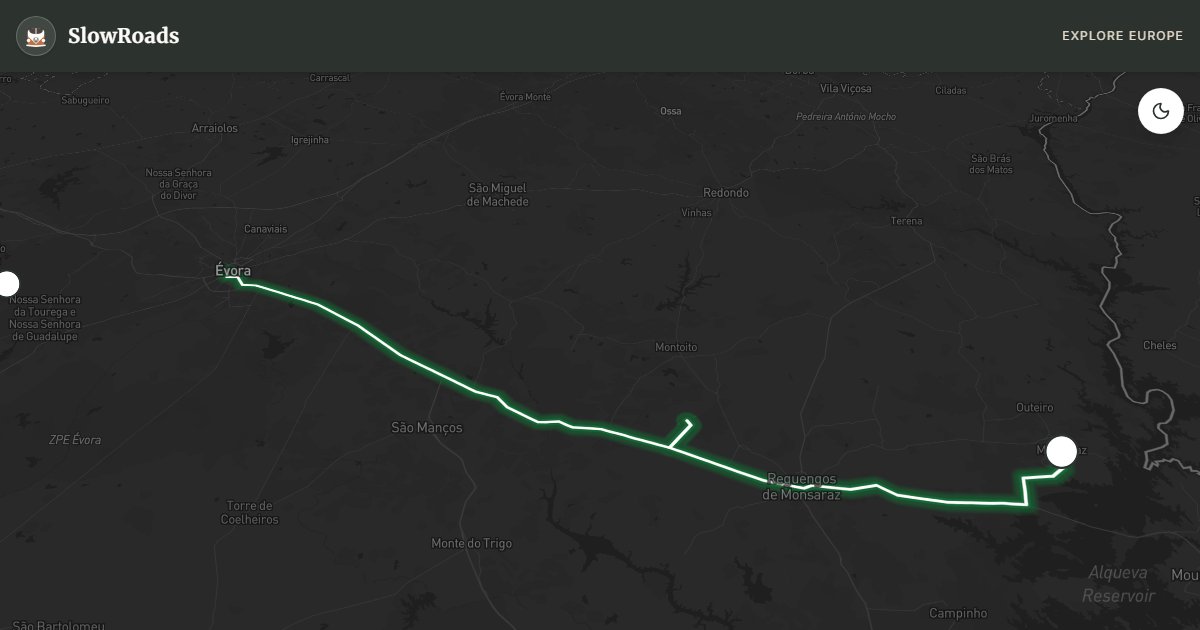
About This Route
Drive from Évora to Monsaraz through cork oak montados, olive plains, and Alqueva's Dark Sky reserve — gentle gradients ideal for classic campervans. Detour to the Almendres cromlech, wander UNESCO Évora, then end in medieval Monsaraz above the reservoir. Spring wildflowers and autumn harvest light beat 40°C summers on open plains. Overnight under IMT 48-hour rules outside protected zones, or at ASA and campsites near Monsaraz — not beside the castle walls. Fuel in Évora or Reguengos before quiet cork country.
Detailed Route Guide
The Alentejo covers roughly a third of Portugal and contains almost nothing — and that emptiness is its magnificence. The drive from Évora to Monsaraz crosses an ancient agricultural landscape of vast horizons and deep silence, in absolute contrast to coastal Portugal. Cork oak and olive trees punctuate rolling plains of golden wheat and red earth under enormous skies. Évora, the walled city anchoring the western end, has been inhabited since the first century BC. Its Roman temple (often called the Temple of Diana) stands in the centre as a reminder that this region fed the empire. The UNESCO old city — whitewashed lanes, baroque churches, medieval towers — rewards an unhurried afternoon on foot.
A short south-west detour leads to the Cromeleque dos Almendres, one of Europe's most important megalithic monuments. Nearly a hundred standing stones in two concentric ovals on a cork-oak hilltop date from around 6000 BC — millennia before Stonehenge. Few tourists find it; at dawn with mist between the stones the stillness is overwhelming. Between the circle and Monsaraz the landscape is pure Alentejo: broad fields, isolated montes, sunflowers under immense sky, white villages on low hills. Alqueva — Europe's largest artificial lake by surface area, created by damming the Guadiana in 2002 — fills a vast basin near the eastern end, blue water appearing almost improbably in the dry plains.
Monsaraz ends the route as one of Portugal's most theatrical hill towns: medieval walls enclose a main street, castle, church, and whitewashed houses above the reservoir. When day-trippers leave, the evening light turns ethereal. For classic and low-power campervan drivers the route is near-perfect: gently rolling terrain, minimal gradients, well-maintained rural roads (N256 and secondary lanes through cork forest), and light traffic. The real pleasure is stopping entirely — pulling onto a gravel track under a cork oak and sitting in the silence. Overnight in an IMT-homologated motorhome is allowed up to 48 hours in the same municipality outside Natura 2000, protected areas, and coastal plans — no camping gear outside the vehicle. Prefer ASA, Camping Monsaraz, or rural tourism near Mourão over unmarked spots.
Alqueva holds Dark Sky / Starlight certification among Europe's darkest certified reserves. On clear nights the Milky Way appears with extraordinary clarity — use a legal overnight or ASA near Monsaraz, kill every light, wait for eye adaptation, and look up. Best seasons: spring (March–May) for wildflowers and green wheat, autumn (September–November) for harvests and mild nights. Summer regularly exceeds 40°C — punishing for vans without strong cooling. Winter is cool and sometimes rainy, with copper low-angle light loved by photographers.
Distances between villages look short, but cork-country lanes invite constant stops for shade, birdlife, and farm shops selling oil and wine by the litre. Fill the tank in Évora or Reguengos before quieter stretches toward Monsaraz; some rural pumps close for lunch. If you chase Dark Sky nights, arrive before dusk to settle a legal pitch, then keep interior lights minimal — even a porch LED can spoil dark adaptation for everyone nearby.
Frequently Asked Questions
Points of Interest
Monsaraz Medieval Village
Town
Cromeleque dos Almendres
Monument
Route Highlights
Nearby Scenic Drives
Route Information
Navigation
* Supported by HERE Technologies, headquartered in Amsterdam, Europe. Precise routing through all waypoints.
* Waze only navigates to the starting point. Use Google Maps for the full scenic route.
Offline GPS Navigation
Download the GPX route file to navigate offline using your favorite GPS device or app (Garmin, TomTom, OsmAnd, Gaia GPS).
Ask Copilot (AI Travel Guide)
Hello! I am your SlowRoads Copilot. I know the Alentejo Cork Route intimately. Ask me about scenic viewpoints, local history, hidden culinary gems, or the best camper spots along the way!