About This Route
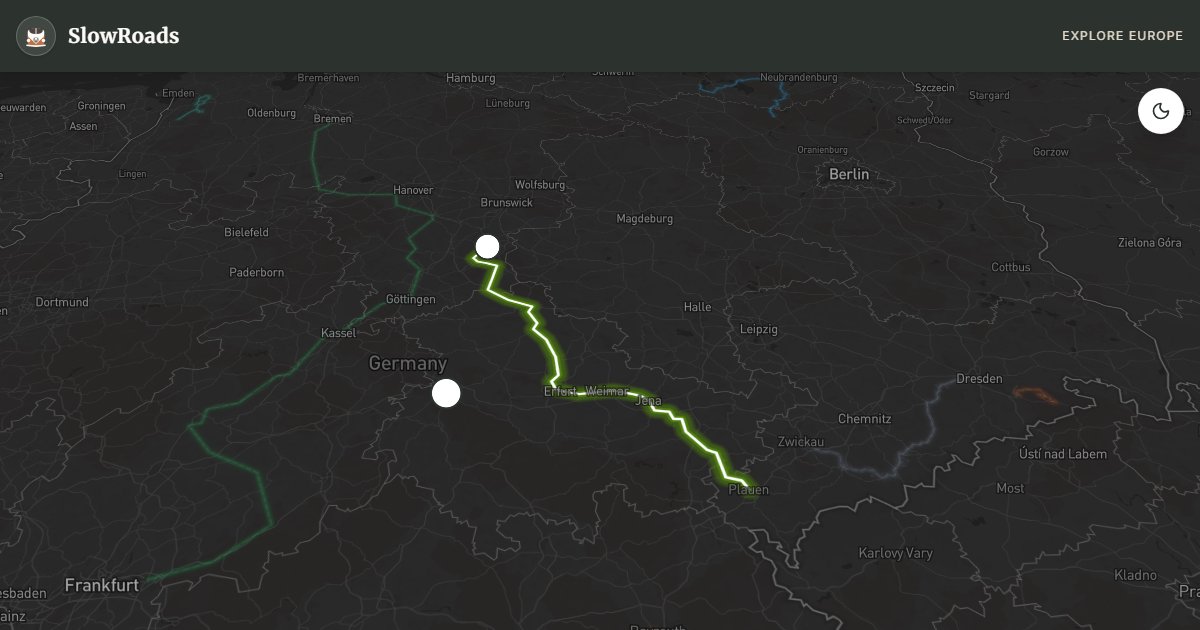
Drive Germany’s Avenue Road central section from Goslar in the Harz toward Thuringia: centuries-old tree tunnels, Weimar culture, and Wartburg nearby on moderate B-roads. Gradients stay manageable for classic campervans; the drama is light through lime and oak canopies rather than mountain passes. Watch for leaf-slick autumn roads and height on forest edges after storms. Stellplätze appear in Harz and Thuringian towns; wild camping is not the norm. Late spring and autumn colour are the showpiece seasons — summer is greener but busier near UNESCO Weimar.
Detailed Route Guide
The German Avenue Road (Deutsche Alleenstraße) is a celebration of one of the most distinctive features of the German landscape: the avenue tree. For centuries, German roads have been lined with rows of mature trees — oaks, limes, poplars, chestnuts — planted both to provide shade for travellers and to mark the boundaries of estates. The result, in autumn especially, is a natural tunnel of extraordinary beauty: branches arching overhead, leaves creating a canopy that filters the light into something golden and cathedral-like. This 2,917-kilometre route (we feature the central segment through the Harz mountains and Thuringia) is Germany's longest scenic route and its most understated.
The highlighted segment begins in Goslar, one of Germany's most perfectly preserved medieval cities. The Rammelsberg mine beneath the city was mined continuously for over 1,000 years (from Roman times to 1988) and, together with the historic Altstadt and the Imperial Palace (Kaiserpfalz) — a magnificent 11th-century fortified residence used by the Holy Roman Emperors — forms a triple UNESCO World Heritage designation. The Kaiserpfalz is remarkable: a great hall 75 metres long, rebuilt in the 19th century on original foundations, still conveying the authority that once made Goslar the occasional seat of imperial power.
From Goslar, the avenue road winds south through the Harz mountains — a distinctive upland plateau of dense mixed forest, wind-eroded granite outcrops, and the highest peak in northern Germany (the Brocken, 1,141m). The Brocken was used as a Stasi listening station during the Cold War and the summit communications towers are still visible from many viewpoints. Wernigerode, with its half-timbered town hall and its hilltop castle, makes an excellent stop; the steam narrow-gauge railway (Harzquerbahn) which climbs to the Brocken from here is one of Germany's great historic rail journeys.
Continuing south, the route enters Thuringia — a state described as Germany's cultural heart. Weimar, compact and walkable, concentrates more cultural significance per square metre than almost any city in Europe: Goethe and Schiller lived and worked here, the Bauhaus design movement was founded here in 1919, Liszt conducted here, and the Duchess Anna Amalia Library holds one of the most beautiful 18th-century library halls in the world. The Wartburg Castle near Eisenach (not quite on the route but worth the detour) is where Martin Luther translated the New Testament into German in 1521-22, while hiding from imperial prosecution — one of the pivotal moments in European intellectual history.
For van drivers, the central avenue road segment is excellent. The Harz section involves some climbing but nothing extreme; the Thuringia section rolls through agricultural plateau country with the long, straight tree-lined avenues that give the route its name. Fuel and facilities are plentiful throughout. Wild camping is not generally permitted in Thuringia or the Harz National Park — use designated campgrounds and Stellplätze instead.
October is the showpiece month when lime and oak alleys turn copper; May brings fresh green canopies that shade a loaded camper without air conditioning. Allow three to five days for Goslar, a Brocken steam-railway day from Wernigerode, Weimar, and a Wartburg detour. Height limits in medieval cores (Goslar, Mühlhausen) push larger vans to outer Parkplätze — walk in and keep the engine cool.
Frequently Asked Questions
Points of Interest
Goslar Imperial Palace
Castle
Wartburg Castle (Eisenach)
Castle
Route Highlights
Route Information
Navigation
* Supported by HERE Technologies, headquartered in Amsterdam, Europe. Precise routing through all waypoints.
* Waze only navigates to the starting point. Use Google Maps for the full scenic route.
Offline GPS Navigation
Download the GPX route file to navigate offline using your favorite GPS device or app (Garmin, TomTom, OsmAnd, Gaia GPS).
Ask Copilot (AI Travel Guide)
Hello! I am your SlowRoads Copilot. I know the German Avenue Road intimately. Ask me about scenic viewpoints, local history, hidden culinary gems, or the best camper spots along the way!