About This Route
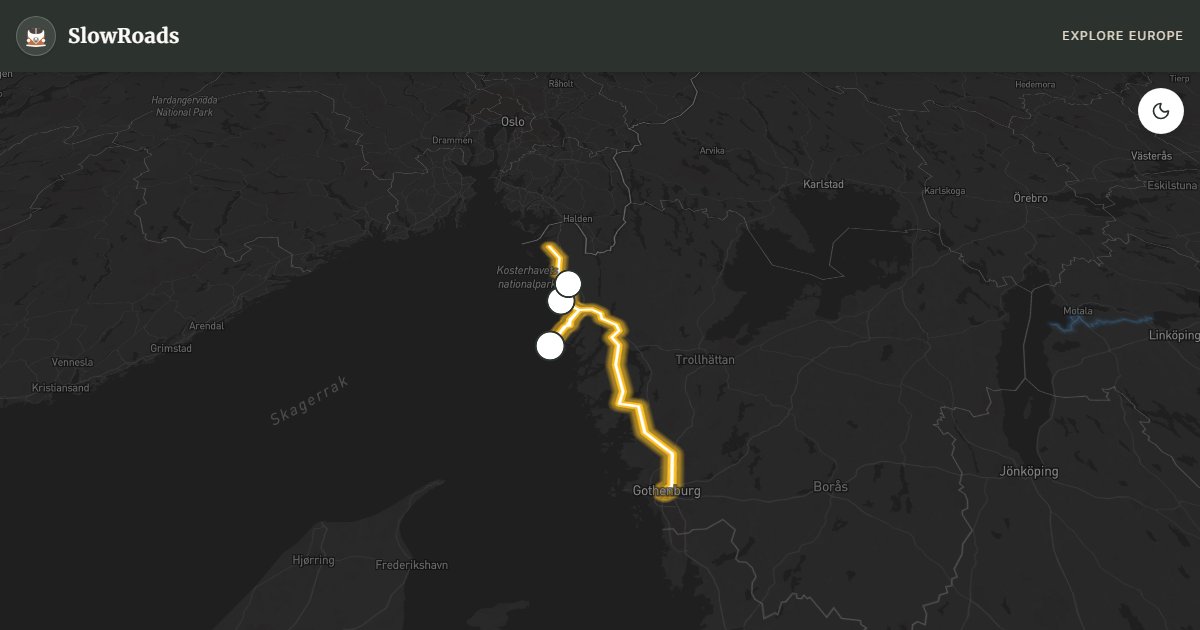
Drive western Sweden's pink-granite coast from Gothenburg to Strömstad via Smögen and Fjällbacka. Flat, well-paved lanes, harbour prawns, and Kattegat swims make this ideal for classic and low-power campervans seeking Atlantic light without mountain grades. Use guest harbours and camps; wild overnighting is restricted. Summer evenings stay long — time sunset at a granite headland. Short daily hops beat rushing the whole coast in one go. A seafood-and-stone SlowRoads classic on Sweden's west. Allow extra time for photo pullouts, fuel stops, and cooling breaks in older vans.
Detailed Route Guide
The Bohuslän coast is one of Scandinavia's most distinctive landscapes: a shattered shoreline of bare pink granite islands, narrow sounds, and wooden fishing villages that have changed little since the herring boom of the 18th century. The 238-kilometre route from Gothenburg to Strömstad follows the old road rather than the motorway, threading between the sea and the forests to deliver a relaxed, genuine coastal Sweden experience. This is not a mountain road with drama and white knuckles — it is a slow road with quality light, good seafood, and the particular peace that comes from driving beside open water.
The highlights arrive one after another. Smögen, arguably Sweden's most photogenic fishing village, has a famous boardwalk — the Smögenbryggan — lined with candy-coloured wooden houses, boat sheds, and the smell of freshly boiled prawns. You can park and walk out to the breakwater for a view that looks almost unchanged from a century ago. Fjällbacka, a little further north, is the other jewel: a small town tucked dramatically between the sea and a sheer granite cliff. The writer Camilla Läckberg set her crime novels here, and the tight alleys and red-painted houses have a slightly timeless quality. Above the town, a cleft in the cliff called Kungsklyftan is worth the five-minute walk. Inland and just off the route, the Vitlycke Museum showcases some of the finest Bronze Age rock carvings in Europe.
For a classic or low-power campervan, this route is close to perfect. The roads are well-surfaced, mostly flat, and carry no intimidating gradients. The one consistent challenge is the density of small roundabouts and speed-control humps through the villages — you will spend a lot of time slowing down and speeding up, which can test a van's warm-up patience. Traffic is light outside midsummer (late June to early August), when the Swedish summer holiday tradition fills every harbour and campsite. Arriving in late August, you will find warm water, empty boardwalks, and prawn boats still landing their catch fresh each morning.
The weather on the Bohuslän coast follows the Swedish rhythm: long, luminous summer days with light that turns golden long before sunset, and a shoulder season of fresh, breezy days ideal for driving with the window open. Wild swimming is a serious local practice — the rock pools and smooth granite slabs form natural lidos at dozens of points along the route. If you are travelling with a van, note that allemansrätten covers tents on foot — not motor vehicles. Do not drive or park on coastal rocks, beaches, or other terrain; overnight only where parking is legal (roadsides and public lots), without camping gear set up. The designated campgrounds at Smögen and Fjällbacka are excellent for longer stays.
Practical pacing keeps the coast enjoyable in an older camper: allow two to four days so you are not racing harbour parking at noon. Detour inland to Tanumshede for the Vitlycke UNESCO rock carvings when the coast road feels busy, then return to the water for evening light on the granite. Fuel is plentiful in larger towns but scarce on peninsula tips — fill before Smögen. Congestion tax does not apply here, but dipped headlights remain mandatory. Late August rewards patience with warm Kattegat water and quieter boardwalks than midsummer.
Frequently Asked Questions
Points of Interest
Smögenbryggan (Boardwalk)
Town
Kungsklyftan (Fjällbacka)
Nature
Vitlycke Rock Carvings
Monument
Route Highlights
Route Information
Navigation
* Supported by HERE Technologies, headquartered in Amsterdam, Europe. Precise routing through all waypoints.
* Waze only navigates to the starting point. Use Google Maps for the full scenic route.
Offline GPS Navigation
Download the GPX route file to navigate offline using your favorite GPS device or app (Garmin, TomTom, OsmAnd, Gaia GPS).
Ask Copilot (AI Travel Guide)
Hello! I am your SlowRoads Copilot. I know the Bohuslän Coast & Archipelago Drive intimately. Ask me about scenic viewpoints, local history, hidden culinary gems, or the best camper spots along the way!