About This Route
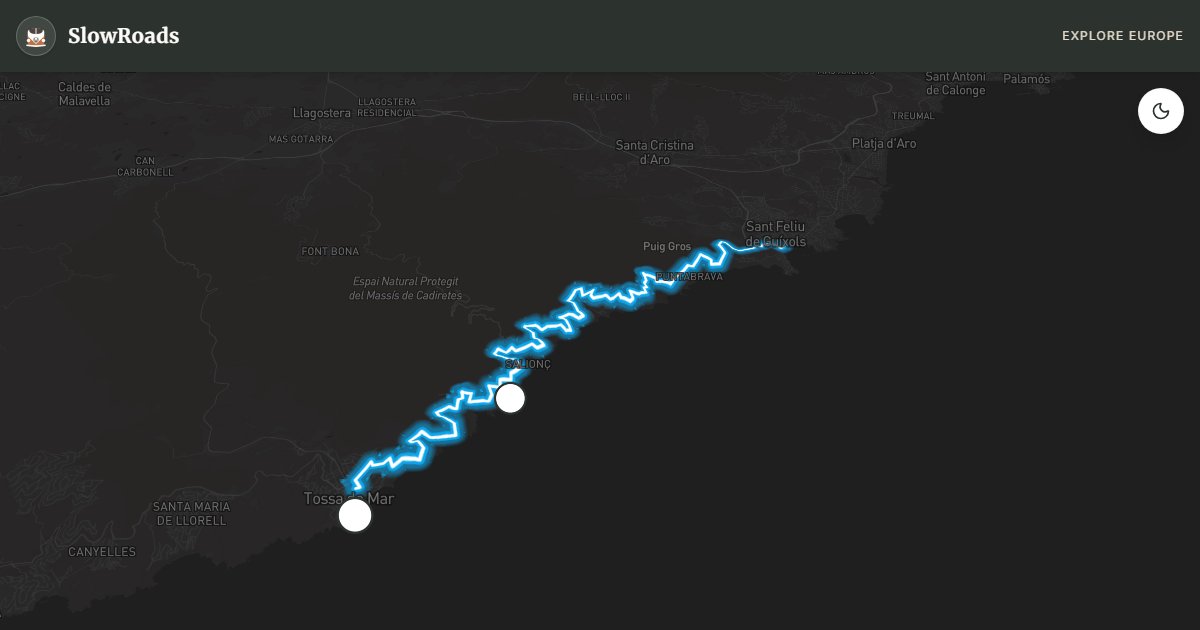
Cruise Catalonia's GI-682 from Tossa de Mar to Sant Feliu de Guíxols — about 20 km of red-granite cliffs, pine scent, and turquoise coves with a legendary curve for every day of the year. The road stays at moderate elevation, so modest engines are not the limit; patience with coaches and tight hairpins is. Classic campervans thrive here with windows down and frequent mirador stops. Swim at Cala Giverola, walk a stretch of the Camí de Ronda, and overnight at designated áreas rather than beach pull-offs. Drive early morning in July–August for empty asphalt and golden light on the Vila Vella walls.
Detailed Route Guide
The Costa Brava — "Wild Coast" in Catalan — earns its name along every centimetre of the GI-682 between Tossa de Mar and Sant Feliu de Guíxols. This short but intensely concentrated 20-kilometre stretch is one of the most dramatic coastal roads in the Mediterranean, a ribbon of asphalt clinging to red granite cliffs above a sea that shifts from deep sapphire to emerald to turquoise depending on the time of day and angle of the sun. The road was built in the early 20th century and has changed little since — its 365 curves (folklore holds there is one for every day of the year) remain as tight and theatrical as ever, making the act of driving it an experience of sustained, low-speed pleasure that rewards patience and attentiveness over speed.
The journey begins in Tossa de Mar, one of the best-preserved medieval walled towns on the Spanish coast. The Vila Vella — the fortified old town — sits on a rocky promontory surrounded by 12th-century walls, towers, and battlements, and was famously described as Marc Chagall's "blue paradise" after he painted here in the 1930s. The town beach below the walls is consistently rated among the finest in Catalonia. From Tossa, the GI-682 climbs immediately into the coast, and within minutes of leaving town you are enclosed in a world of pine-scented air, red granite walls, and flashes of impossibly blue water visible through the trees and between the curves. Each bend reveals a new cove, a new angle of cliff, a new surprise of colour and geography.
Along the route, numerous miradors (viewpoints) and pull-offs allow you to stop and take in the panorama — some of the best views are found not at official viewpoints but at spontaneous gaps in the cliff where the sea suddenly opens up beneath you. The coves visible from the road — Cala Giverola, Cala Pola, Cala Salions — are accessible on foot via walking trails that begin along the road's edge, and several can be reached by kayak from Tossa or Sant Feliu. The Cami de Ronda, an ancient coastal footpath that once served as a patrol route for customs officers hunting smugglers, runs along much of this coastline at water level, and walking even a short section of it reveals hidden beaches and rock arches unreachable by road. The drive ends in Sant Feliu de Guíxols, a charming town with a handsome seafront esplanade, a Benedictine monastery dating to the 10th century, and a lively market scene.
For classic and low-power campervan drivers, this road is a pure joy — and one of the rare routes where modest power is not a limitation but an asset. The curves are tight enough that speed is never tempting, and the rhythm of the road suits the van's relaxed character perfectly. Windows down, engine ticking over contentedly, the scent of Mediterranean pine drifting through the cab — this is slow travel at its finest. The road is narrow and has limited overtaking opportunities, so be patient with traffic and pull over at viewpoints to let frustrated drivers pass. The best time to drive is early morning, when the light is at its most golden and the day-trippers have not yet arrived. The GI-682 is not recommended for very large motorhomes, but a standard classic campervan handles it without difficulty.
Frequently Asked Questions
Points of Interest
Old Town Tossa de Mar
Town
Cala Giverola
Nature
Route Highlights
Route Information
Navigation
* Supported by HERE Technologies, headquartered in Amsterdam, Europe. Precise routing through all waypoints.
* Waze only navigates to the starting point. Use Google Maps for the full scenic route.
Offline GPS Navigation
Download the GPX route file to navigate offline using your favorite GPS device or app (Garmin, TomTom, OsmAnd, Gaia GPS).
Ask Copilot (AI Travel Guide)
Hello! I am your SlowRoads Copilot. I know the Costa Brava Coastal Drive intimately. Ask me about scenic viewpoints, local history, hidden culinary gems, or the best camper spots along the way!