About This Route
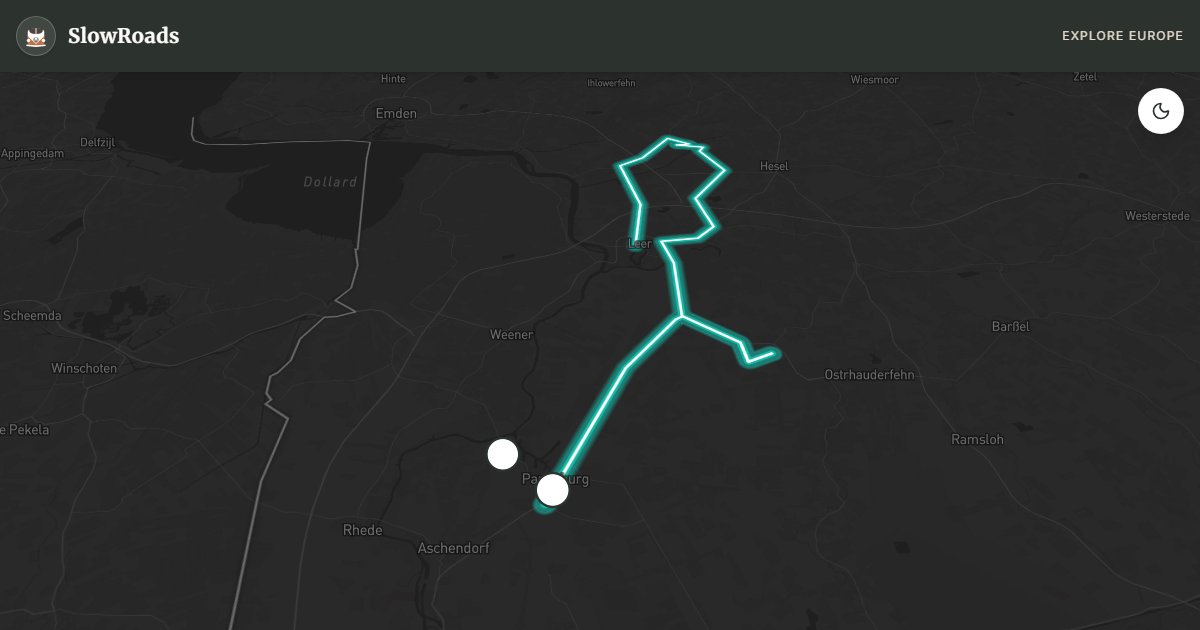
Drive the German Fehn Route from Papenburg to Leer: straight peat canals, white drawbridges, windmills, and East Frisian tea culture on a landscape found nowhere else in Germany. Completely flat — perfect for classic and low-power campervans — with the pace set by canal boats and village 30 zones. Stellplätze appear in Fehn towns; wild camping on canal banks is not allowed. Carry coins for small parking machines and expect strong North Sea winds. Late spring to early autumn keeps museums and tea rooms open; winter is atmospheric but many craft stops close midweek.
Detailed Route Guide
The German Fehn Route is one of the most unusual and least-visited scenic routes in the country — a journey through a landscape that exists nowhere else in Europe with quite this completeness. The Fehn (from the Dutch 'Veen', meaning peat bog) is a system of long, straight canals cut through the lowland peat bogs of northwestern Germany between the 17th and 19th centuries to drain the land for agriculture and transport the harvested peat to market. The villages that grew along these canals followed an extraordinary pattern: each farmhouse was built directly on the canal bank, with a small jetty for the farmer's boat, a drawbridge connecting to the road on the other side, and a perfect symmetry of buildings, water, and green fields repeating for kilometre after kilometre.
The effect, especially viewed from above or from one of the drawbridges looking down the canal, is hypnotic — a landscape of pure geometry that seems designed rather than evolved. The white wooden drawbridges (Klappbrücken) are the route's most iconic element, each one a delicate mechanism that can be raised by hand to allow boats to pass. The Alte Pickertweg canal route near Rhauderfehn has the highest concentration of original Fehn bridges in existence, and several are still operational on request.
Papenburg, the route's starting point, is an extraordinary town — it seems impossible that a settlement of 35,000 people could be entirely built on a canal grid with no central hill or gathering point, yet here it is. The Meyer Werft shipyard, hidden within the town, is one of the most significant shipbuilding enterprises in Europe, constructing massive cruise ships (including ships for Royal Caribbean and Disney Cruise Line) that are then floated down the Ems River to the sea on a delicate logistics operation involving half of northwest Germany holding their breath. Shipyard tours can be booked in advance and are genuinely fascinating — watching a 300-metre cruise ship navigate a 25-metre-wide canal is an unforgettable sight.
The cultural identity of the Fehn region is strongly Dutch-influenced — not surprising given the proximity and the fact that Dutch drainage engineers built much of this landscape. The windmills that punctuate the horizon, the characteristic farmhouse architecture with its long narrow buildings perpendicular to the canal, and the local dialect all carry traces of the Netherlands. The East Frisian tea tradition — East Frisia consumes more tea per person than any other region in Germany, with a specific ritual involving cream and rock candy — is taken very seriously in the Fehn village cafés.
For van drivers, this is the ultimate easy route. The Fehn country is as flat as anywhere in Germany — flatter than most, since it was originally below sea level and required drainage to become habitable. No gradient, no steep section, nothing that challenges a weak engine. The only navigational challenge is finding parking near the narrower canal roads where there is frequently no verge. The route is best driven slowly with frequent stops at the bridges and canal crossings, allowing the peculiar beauty of this man-made landscape to accumulate.
Classic campervans and loaded older campers thrive here: zero meaningful gradients, short daily stages, and frequent reasons to stop at drawbridges for photos. Park considerately on canal verges — many Fehn lanes have no hard shoulder — and overnight only on Stellplätze or campgrounds in Papenburg, Rhauderfehn, or Leer. Carry euro coins for small parking machines and expect strong North Sea winds that cool a parked van quickly. East Frisian tea rooms reward unhurried afternoons; that slow rhythm is the point of the Fehn landscape.
Frequently Asked Questions
Points of Interest
Papenburg Canals
Town
Meyer Werft (Shipyard)
Monument
Route Highlights
Nearby Scenic Drives
Route Information
Navigation
* Supported by HERE Technologies, headquartered in Amsterdam, Europe. Precise routing through all waypoints.
* Waze only navigates to the starting point. Use Google Maps for the full scenic route.
Offline GPS Navigation
Download the GPX route file to navigate offline using your favorite GPS device or app (Garmin, TomTom, OsmAnd, Gaia GPS).
Ask Copilot (AI Travel Guide)
Hello! I am your SlowRoads Copilot. I know the German Fehn Route intimately. Ask me about scenic viewpoints, local history, hidden culinary gems, or the best camper spots along the way!