About This Route
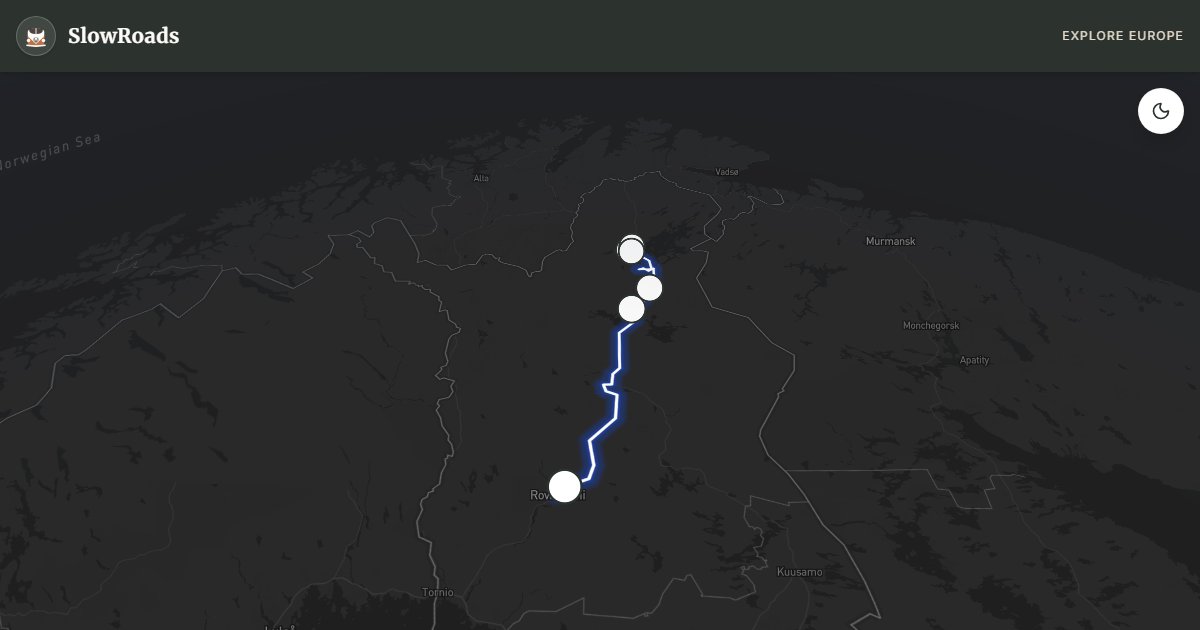
North from Rovaniemi through boreal forest to Saariselkä and Lake Inari — Arctic Circle markers, Sámi culture, and midnight sun on the excellent E75. Classic and low-power campervans face distance and reindeer more than gradients; keep speeds modest at dusk when herds cross. Winter needs studded tyres and real cold planning; summer is the gentle window for older engines. Jokamiehenoikeus covers tents away from homes — vans overnight only at campsites or clearly legal parking. Best June–August for slow vans that want light, fuel stops, and time to linger at Inari.
Detailed Route Guide
Finnish Lapland is Europe's accessible Arctic — a landscape of endless birch and pine forest, open fells, and lakes that hold light long after midnight in summer. This route runs north from Rovaniemi, the provincial capital straddling the Kemijoki river, along the E75 highway through Sodankylä to Saariselkä and finally to Inari on the shores of Finland's sacred northern lake. Unlike Norway's fjord roads, Lapland's main arteries are wide, well-maintained, and van-friendly; the challenge is not gradient but distance, wildlife, and the psychological strangeness of driving at 11 PM in full daylight.
The Arctic Circle crossing at Santa Claus Village, six kilometres south of central Rovaniemi, is the ceremonial threshold — a line painted across the asphalt where tourists photograph themselves stepping from temperate zone into the land of the midnight sun. Beyond it, the forest deepens, reindeer appear on the roadside without warning (slow down at dusk — collisions are common and dangerous for both animal and van), and roadside pull-offs offer bilberry picking in August and aurora possibilities from September onward.
Saariselkä is Lapland's fell resort without the alpine pretension — low rounded hills rather than peaks, with marked trails to Kaunispää and Iisakkipää offering views over a sea of green that stretches to Russia. The village has supermarkets, fuel, and several campsites accustomed to German and Dutch overlanders in VW buses. Tankavaara, midway between Sodankylä and Saariselkä, preserves the story of Lapland's gold rush in a cluster of log buildings; it sits at the edge of Urho Kekkonen National Park, Finland's second-largest, where day hikes into pine and lichen forest require no permit.
Inari is the spiritual end point — a small village on a vast lake where the Siida museum presents Sámi history with dignity and depth rare in Nordic tourism. The Pielpajärvi wilderness church, reached by a 45-minute forest walk from the Siida car park, is a timber structure from 1760 that feels unchanged by centuries. For classic and low-power campervans, this route is mechanically straightforward on E75 — no mountain passes, no unsurfaced sections on the main line. Fuel stops exist at Rovaniemi, Sodankylä, Saariselkä, and Inari; carry a jerry can if you plan side trips into the national park on gravel forest roads. June through early August delivers the midnight sun experience; May and September offer quieter roads and golden light. Allow three to four days minimum — rushing Lapland defeats the entire SlowRoads philosophy.
Measure Lapland in overnight bases — Rovaniemi, Sodankylä, Saariselkä, Inari — not in continuous E75 hours. Reindeer at dusk are the main hazard for classic and low-power campervans. Jokamiehenoikeus covers tents away from homes; vans overnight at campsites or legal parking only. Carry extra fuel for gravel park spurs.
Siida in Inari is worth a half day — Sámi history presented with care rare in Arctic tourism. The Pielpajärvi church walk needs decent shoes and insect protection in July. Classic and low-power campervans that accept three to four nights north of the Circle understand Lapland; those who blast E75 in two days do not.
Frequently Asked Questions
Points of Interest
Arctic Circle Crossing
Monument
The official Arctic Circle line at Santa Claus Village — a ceremonial gateway to the far north.
Tankavaara Gold Village
Town
A living museum of Lapland gold panning history beside Urho Kekkonen National Park.
Saariselkä Fell Centre
Nature
Gateway to Finland's highest road-access fells and short hikes above the treeline.
Siida Sámi Museum
Monument
Award-winning museum and nature centre documenting Sámi culture and Arctic ecology.
Lake Inari Shore
Nature
Finland's third-largest lake — mirror-still water, islands, and midnight sun reflections in June.
Pielpajärvi Wilderness Church
Monument
A timber church from 1760 reached by a short forest trail — one of Lapland's most atmospheric sites.
Route Highlights
Route Information
Navigation
* Supported by HERE Technologies, headquartered in Amsterdam, Europe. Precise routing through all waypoints.
* Waze only navigates to the starting point. Use Google Maps for the full scenic route.
Offline GPS Navigation
Download the GPX route file to navigate offline using your favorite GPS device or app (Garmin, TomTom, OsmAnd, Gaia GPS).
Ask Copilot (AI Travel Guide)
Hello! I am your SlowRoads Copilot. I know the Lapland Arctic & Midnight Sun intimately. Ask me about scenic viewpoints, local history, hidden culinary gems, or the best camper spots along the way!