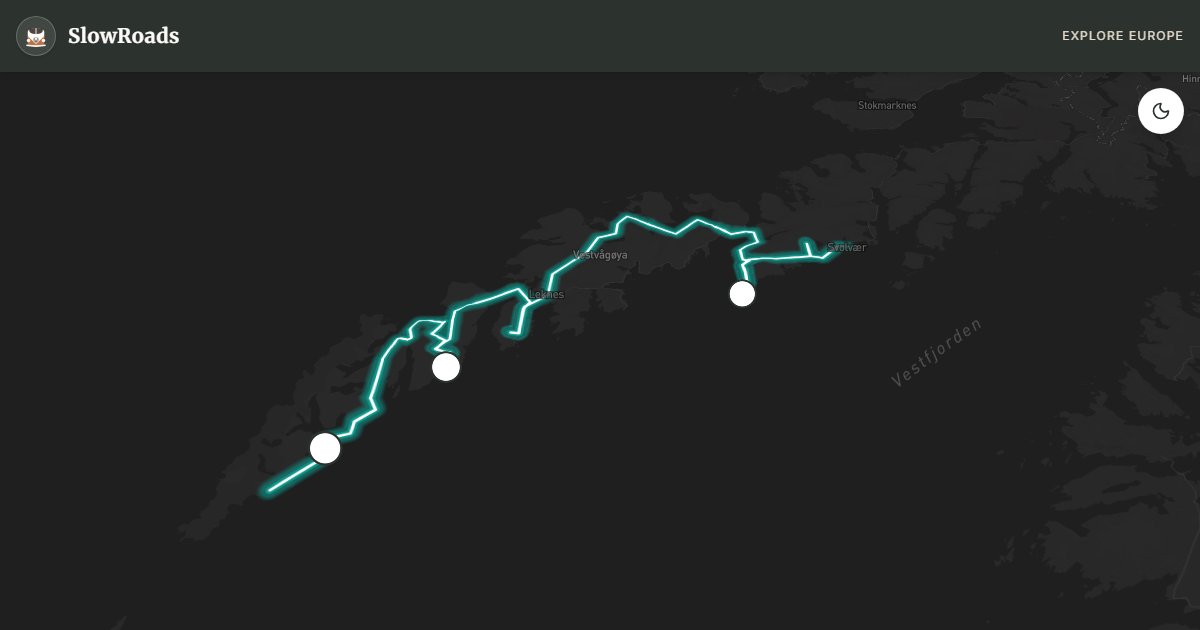
About This Route
Norwegian Scenic Route Lofoten follows the E10 through jagged peaks, turquoise channels, and fishing villages from Raftsundet to Å. Mostly flat but windy and narrow — perfect slow travel for classic and low-power campervans if you book Bodø–Moskenes ferries early in summer. Camps and rorbuer parking fill fast July–August. Watch for cyclists and coaches on single-lane bridges. Arctic light and stockfish racks define the stay — allow several days, not a dash. Ferry logistics and wind forecasts matter as much as the road.
Detailed Route Guide
The Lofoten archipelago is one of those places that stops working as a rational concept the moment you actually arrive. You have seen the photographs — the red and yellow rorbuer fishing huts reflected in glassy water, the Dolomite-sharp peaks rising directly from a turquoise sea that has no business being that colour at 68 degrees north — and you have, quite reasonably, assumed that reality would be a slight disappointment. It isn't. The E10, known as Lofoten Scenic Route or simply the "Lofotenveien", forms the spine of the official Norwegian Scenic Route Lofoten — about 166 kilometres from Raftsundet to Å including signed detours to villages such as Henningsvær and Nusfjord. The main E10 run from Svolvær to Å alone is roughly 130 kilometres of bridges and tunnels through landscapes that feel simultaneously Norwegian and Mediterranean and entirely like nowhere else on earth. This is slow travel in its most complete form.
The route passes through or near the key villages of Kabelvåg, Henningsvær, Leknes, Nusfjord, Hamnøy, and Reine before terminating at the tiny end-of-the-road community of Å (pronounced "Oh"), where the road literally stops at the sea. Each village has its own character. Henningsvær, built across a cluster of small islands and accessible by a slender bridge, is famous for its football pitch surrounded by cod-drying racks — an image that encapsulates everything about Lofoten's improbable geometry. Nusfjord is one of Norway's oldest and best-preserved fishing villages, its wooden warehouses and fishing boats unchanged in feel for over a century. Reine, regularly voted Norway's most beautiful village, sits beneath a wall of jagged peaks reflected in the still water of Reinefjord. The road between these places is itself an experience: low bridges over open channels, tunnels through mountain bases, and constant sweeping views of sea and sky.
For a classic or low-power campervan, the E10 through Lofoten is one of the great van destinations of Europe. The road is predominantly flat and well-surfaced, well within the capabilities of any engine regardless of horsepower. The distances between services are manageable — petrol stations exist in Svolvær, Leknes, and Å — and campsites are well established — tent camping under allemannsretten is common, while vans overnight only where parking is legal. Norway's allemannsretten (right to roam) allows free tent camping on uncultivated land, and the islands are full of spectacular spots: rocky capes above the sea, grassy shelves above fishing villages, and quiet bays. Campervans may overnight only where parking is legal — not by driving onto beaches or meadows. The key logistical consideration is the ferry to reach the islands: either fly into Svolvær or Leknes, drive from the mainland via the E10 (Lofast / Raftsundet — no Narvik bridge into Lofoten), or take a ferry from Bodø to Moskenes. The latter is the most atmospheric and arrives at the quieter southern end.
Seasonally, Lofoten is a true year-round destination with radically different moods. The Midnight Sun runs from late May to mid-July: 24-hour daylight that utterly confuses the body clock and bathes the islands in a continuous golden light that photographers travel specifically to chase. The Northern Lights (Aurora Borealis) are most reliably visible between October and March — the islands' coastal location and relatively low light pollution make them one of Norway's best aurora-watching spots. The peak tourist season (July–August) brings crowds but also long warm evenings, boat trips in the fjords, and the year's best weather. Shoulder seasons — June and September — offer the balance of good weather, lower crowds, and excellent light. Even winter on Lofoten has its adherents: the snow-capped peaks, frozen fjords, and near-total quiet make for an intense and beautiful experience, though snow can affect driving on some smaller roads. Whatever season you choose, allow at least three to four days and resist the urge to rush.
Frequently Asked Questions
Points of Interest
Reinebringen View
Nature
The most famous view in Lofoten. Though it requires a steep hike, the overview of Reine and its surrounding islands is unmatched.
Henningsvær Football Pitch
Town
An iconic football pitch surrounded by drying racks for cod, built on a rocky islet at the end of the village.
Nusfjord Historic Village
Town
One of Norway's oldest and best-preserved fishing villages, tucked away in a narrow fjord.
Route Highlights
Route Information
Navigation
* Supported by HERE Technologies, headquartered in Amsterdam, Europe. Precise routing through all waypoints.
* Waze only navigates to the starting point. Use Google Maps for the full scenic route.
Offline GPS Navigation
Download the GPX route file to navigate offline using your favorite GPS device or app (Garmin, TomTom, OsmAnd, Gaia GPS).