About This Route
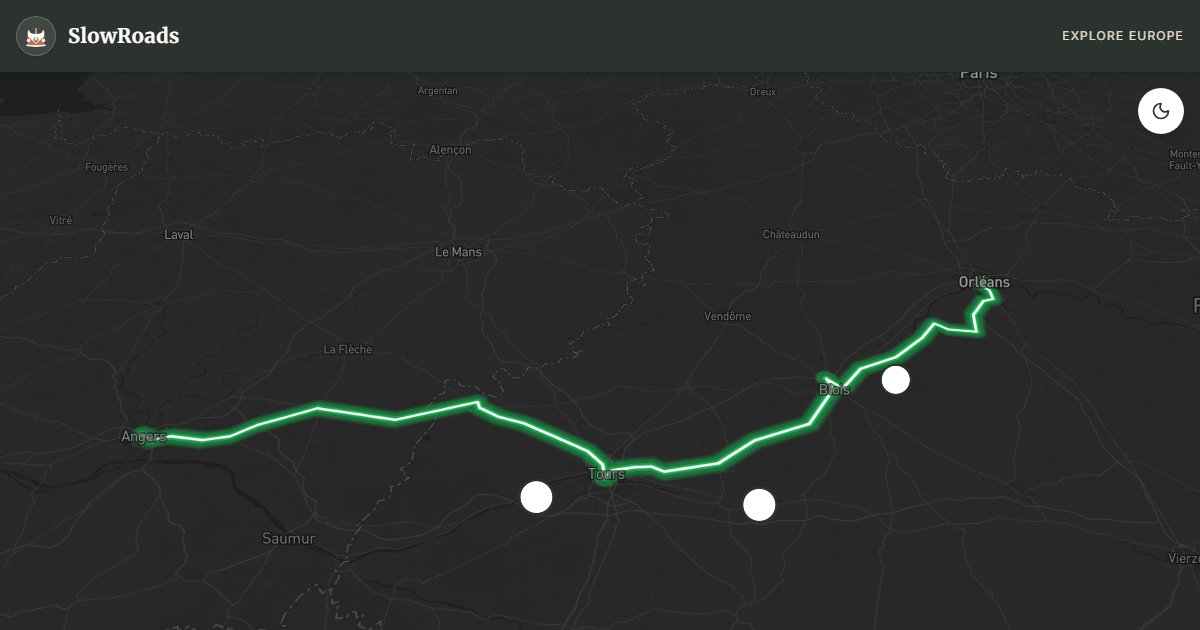
Cruise the Loire Valley from Orléans to Angers through UNESCO château country: Chambord, Chenonceau, Villandry gardens and flat river D-roads. Almost no gradients — one of France's easiest scenic drives for older low-power campervans. Allow 4–6 days for two châteaux a day, cave wine tastings in tufa cellars and riverside aires. Arrive before 10am at Chambord and Chenonceau in July–August; overnight on official aires and campgrounds rather than informal riverbanks. Vouvray, Chinon and Saumur-Champigny reward unhurried cellar stops between the great houses.
Detailed Route Guide
The Loire Valley is the 'Garden of France' — a description that understates both its physical beauty and its cultural weight. The river Loire, the longest in France, flows through a valley of flat alluvial plains, white tufa stone cliffs, and the densest concentration of Renaissance châteaux in the world. The 233-kilometre route from Orléans to Angers follows the river through a UNESCO World Heritage-listed landscape that shaped French civilization from the 15th to 17th centuries, when the royal court spent its summers along these banks and the aristocracy competed in the construction of ever more extravagant country houses.
The châteaux vary radically in character and setting. Chambord, the largest, is an exercise in almost insane ambition: a hunting lodge designed for François I with some 440 rooms (traditionally cited), around 280 fireplaces, and a double-helix staircase attributed (controversially) to Leonardo da Vinci, rising in the centre of a forest of 5,440 hectares. The building is not intimate or cosy — it is theatrical, a stage set for royal power — and its reflection in the surrounding moat at dawn or dusk, with no other structures in sight, produces one of the great architectural spectacles in France. Chenonceau, by contrast, is the most elegant and most visited: a Renaissance manor built over the Cher river on a bridge of five arches, extended by Catherine de Médicis into a gallery that spans the river completely. Its setting, with the river running beneath the château and formal gardens on both banks, is unmatched.
Beyond the great châteaux, the Loire Valley rewards slower exploration. The tufa stone villages — Troo, Montoire, Lavardin — have cave houses (troglodytes) carved directly into the cliff faces, inhabited since the Middle Ages and still used as wine cellars and occasional residences. The Château de Villandry, near Tours, is famous for its formal ornamental and kitchen gardens rather than its architecture — six formal gardens laid out across four terraces of geometric parterres, tended to obsessive precision. The old town of Amboise, where Leonardo da Vinci spent his last years at the invitation of François I and is buried in the chapel of the royal château, combines the Loire's historical richness with one of its most pleasant riverside settings.
The Loire Valley's wines are among France's most distinctive. The appellation covers a long stretch of the valley and includes dramatically different styles: Muscadet (bone-dry, mineral, from the Nantais region near the mouth of the Loire), Sancerre and Pouilly-Fumé (Sauvignon Blanc, crisp and herbaceous, from the upper Loire), Vouvray (Chenin Blanc — can be dry, off-dry, or sparkling), Bourgueil and Chinon (Loire Reds, Cabernet Franc dominant), and Crémant de Loire (high-quality sparkling wines). The valley's cave wineries (often carved into the tufa cliffs) are one of the Loire's most distinctive experiences.
For van drivers: the Loire Valley is one of the best routes in France for a low-powered vehicle. The terrain is as flat as the river valley itself — essentially zero significant elevation changes along the main D route following the river. The road (primarily the D952/D751) is a pleasant two-lane passing through or near every major château. Some of the finest châteaux (Chambord, Cheverny) require detours on minor roads through the Sologne forest. Traffic management at peak season (July-August) can create queues at Chambord and Chenonceau — arrive before 10am or after 4pm. Motorhome parking at most châteaux. Overnight parking rules vary by commune — use official aires and campgrounds rather than informal riverbank stops.
Frequently Asked Questions
Points of Interest
Château de Chambord
Castle
Château de Chenonceau
Castle
Villandry Gardens
Nature
Route Highlights
Route Information
Navigation
* Supported by HERE Technologies, headquartered in Amsterdam, Europe. Precise routing through all waypoints.
* Waze only navigates to the starting point. Use Google Maps for the full scenic route.
Offline GPS Navigation
Download the GPX route file to navigate offline using your favorite GPS device or app (Garmin, TomTom, OsmAnd, Gaia GPS).
Ask Copilot (AI Travel Guide)
Hello! I am your SlowRoads Copilot. I know the Loire Valley Châteaux Route intimately. Ask me about scenic viewpoints, local history, hidden culinary gems, or the best camper spots along the way!