About This Route
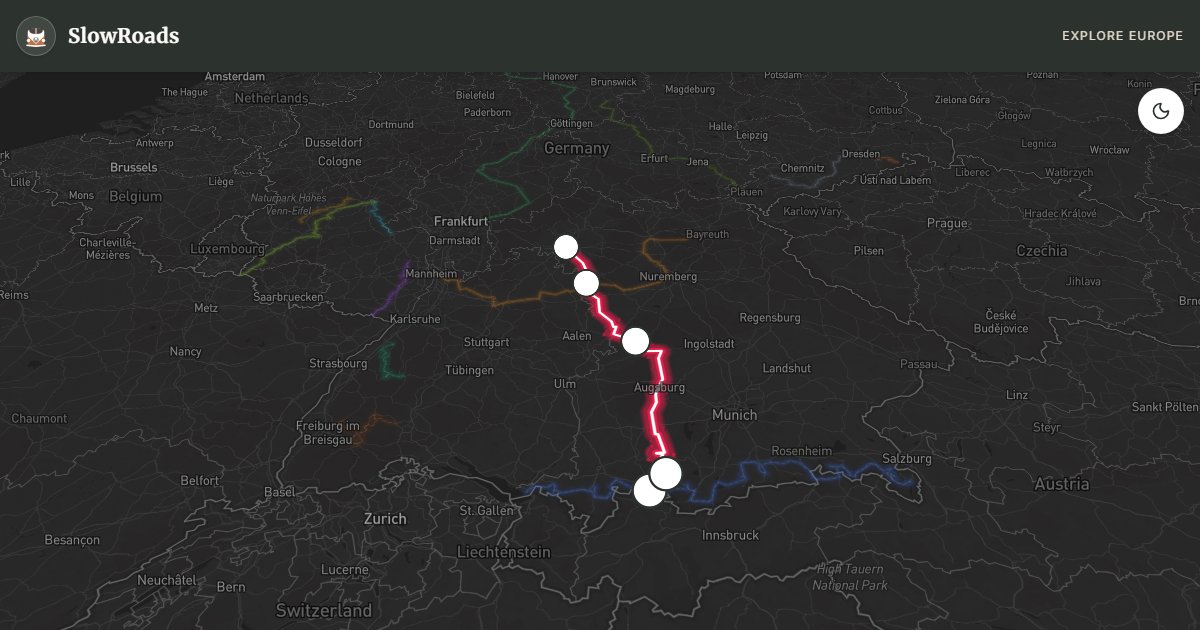
Drive Germany’s Romantic Road from Würzburg’s UNESCO Residenz through Rothenburg ob der Tauber to Neuschwanstein near Füssen. Medieval walled towns, the Ries meteorite crater at Nördlingen, and alpine foothills unfold over about 322 km of well-signed B-roads. Most of the route is flat river-valley cruising suited to classic and low-power campervans; only the final Allgäu approach asks for lower gears. Use outer Parkplätze at historic gates, overnight at Wohnmobil-Stellplätze near Rothenburg, Dinkelsbühl, or Forgensee, and arrive before coach tours fill the old towns. Late spring and early autumn bring clearer light and thinner crowds than July–August.
Detailed Route Guide
Germany's most beloved scenic drive, the Romantic Road stretches 322 kilometres from the Franconian wine country of Würzburg south through medieval Swabia to the foot of the Bavarian Alps near Füssen. Its name was coined in 1950 to market the route to American soldiers stationed in West Germany, and it has captured travellers' imaginations ever since. The road follows ancient trade routes and pilgrimage paths — the same tracks that Roman legions once marched along and medieval merchants traded upon.
The journey begins in Würzburg, a baroque masterpiece on the Main River. The Prince-Bishops' Residenz, a UNESCO World Heritage Site, is arguably the finest baroque palace in Germany and an unmissable stop. Its ceiling fresco by Tiepolo is the largest in the world. From here you thread south through the Tauber Valley, where the landscape seems frozen in the 15th century. Rothenburg ob der Tauber is the jewel of the route: a completely intact medieval walled town with cobblestone streets, half-timbered houses, and a Christmas market atmosphere year-round. Allow at least half a day here — longer if you want to walk the complete town wall circuit and climb the market tower for panoramic views over the rooftops.
South of Rothenburg, the route enters the Ries, a circular depression created by a meteorite impact 15 million years ago. The town of Nördlingen still sits entirely within the original impact crater, and its complete medieval wall — one of only three in Germany — offers a unique full-circle walk. Dinkelsbühl, between Rothenburg and Nördlingen, is equally well-preserved yet sees far fewer visitors: a charming stop where you can actually park your van right by the town gate. Beyond Augsburg — Bavaria's oldest city, founded by the Romans — the country opens into the Allgäu foothills before the Alps emerge dramatically on the southern horizon. The finale near Füssen delivers Schloss Neuschwanstein, the fairy-tale castle built by eccentric King Ludwig II and a primary inspiration for Disneyland's Sleeping Beauty Castle. Hohenschwangau, where Ludwig grew up, stands just below and is equally rewarding.
For classic campervan and low-power van drivers, the Romantic Road is one of Germany's most engine-friendly scenic routes. From Würzburg to Augsburg, the route is largely flat, following river valleys with barely a gradient to worry about. Only the final section toward Füssen involves any meaningful climb as the road approaches the Alps. The road surface throughout is excellent and well-signposted with distinctive brown "Romantische Straße" markers. Speeds are low through the old towns, meaning no rush and time to find a parking spot. Designated Wohnmobil-Stellplätze (motorhome parking areas) are available in most towns. Wild camping is not officially permitted in Bavaria but several excellent campgrounds are positioned along the route near Rothenburg, Dinkelsbühl, and by the Forgensee lake near Füssen.
The best seasons are late spring (May to June) and early autumn (September to October). May brings wildflowers to the Tauber Valley and crystal-clear air for alpine views. September sees the Franconian grape harvest in Würzburg and golden afternoon light across the meadows. Summer (July to August) is the busiest period — coach tours fill Rothenburg by mid-morning. Arrive before 9am or stay overnight to experience the town after the day-trippers leave. December brings famous Christmas markets; the snow-dusted streets of Rothenburg in winter are genuinely magical.
Frequently Asked Questions
Points of Interest
Residenz Würzburg
Castle
Rothenburg ob der Tauber
Town
Harburg Castle
Castle
Neuschwanstein
Castle
Wieskirche
Monument
Route Highlights
Nearby Scenic Drives
Route Information
Navigation
* Supported by HERE Technologies, headquartered in Amsterdam, Europe. Precise routing through all waypoints.
* Waze only navigates to the starting point. Use Google Maps for the full scenic route.
Offline GPS Navigation
Download the GPX route file to navigate offline using your favorite GPS device or app (Garmin, TomTom, OsmAnd, Gaia GPS).
Ask Copilot (AI Travel Guide)
Hello! I am your SlowRoads Copilot. I know the Romantic Road intimately. Ask me about scenic viewpoints, local history, hidden culinary gems, or the best camper spots along the way!