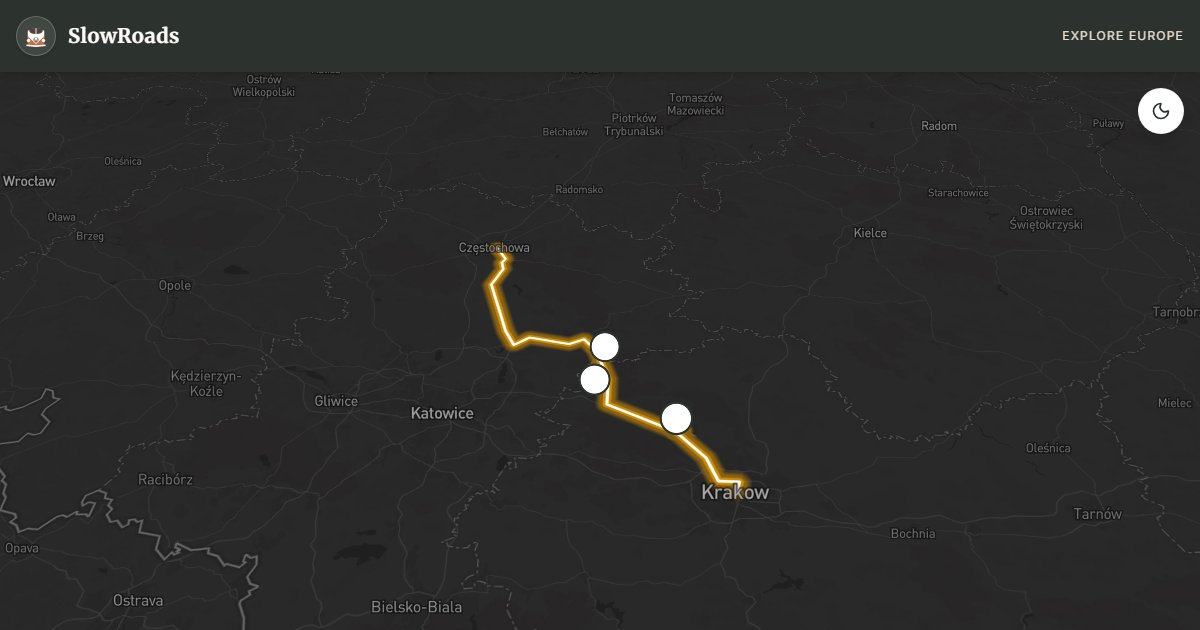
About This Route
Follow the Trail of the Eagles’ Nests from Kraków toward Częstochowa — about 132 km of medieval castles on Jurassic limestone for slow classic campervans. Moderate hills link Pieskowa Skała, Ogrodzieniec ruins, and quiet highland villages without alpine grades. Multi-day pacing suits older low-power vans; park below castles and walk up. Campsites and agroturystyka only — no wild camping on crag lay-bys. May–June and September beat summer coach peaks. Fill fuel in Kraków or Częstochowa before quieter Jura stretches. Headlights day and night; limestone lanes can be polished when wet.
Detailed Route Guide
The Trail of the Eagles' Nests (Szlak Orlich Gniazd) is one of Poland's greatest medieval heritage drives — an about 132-kilometre route through the Polish Jurassic Highland (Jura Krakowsko-Częstochowska) connecting about 25 ruined or preserved castles, many built or expanded during the reign of King Casimir III (the Great) in the 14th century to defend the western border of the Polish kingdom against Bohemian and Silesian incursions. The route takes its name from the dramatic siting of many of these fortresses: perched atop isolated limestone pinnacles and crags that rise abruptly from the surrounding forest, some accessible only by ladders cut into the rock, giving them the inaccessible appearance of an eagle's eyrie. The landscape itself is one of the most unusual in Central Europe — a karst highland of white and grey limestone outcrops, caves, deep wooded valleys, and the distinctive "inselberg" rock stacks that look more like something from a desert landscape than the heart of Europe.
The route begins in Kraków — one of Europe's finest medieval cities, the royal capital of Poland from the 10th to 16th centuries, with its magnificent Wawel Castle and Cathedral, intact old town, and Jewish Kazimierz quarter. From Kraków the route heads north through the Ojców National Park (the smallest national park in Poland but among its most beautiful) where the limestone pinnacle known as Hercules's Club (Maczuga Herkulesa) stands beside the Prądnik river gorge — one of the most photographed natural formations in Poland. Pieskowa Skała Castle, perched on a vertical crag above the gorge, is the finest surviving castle on the entire trail: a Renaissance masterpiece of arcaded courtyards and elaborate stonework, built in the 16th century on a 14th-century Gothic foundation. Continuing north through Ogrodzieniec — where the castle ruins merge dramatically with the natural rock, making it impossible to tell where fortification ends and cliff begins — to the route's northern terminus at Częstochowa, home of the famous Black Madonna icon at the Jasna Góra monastery, Poland's most important religious pilgrimage site.
For older and low-power campervans the Eagles' Nests Trail is manageable — a hilly highland drive, not an alpine pass. Jurassic gradients rarely exceed about 6–7%, surfaces are generally sound, and heavy goods traffic is limited. The real challenge is length: about 132 km with many castle stops easily becomes a multi-day trip. Budget at least three days, overnighting near Ojców and Ogrodzieniec. In Ojców National Park summer vehicle access inside the gorge is restricted — park at entrance lots and walk or cycle in.
Spring is arguably the finest season for this route: April and May bring wildflowers to the limestone meadows and the deciduous forest of the gorges in fresh leaf, while the crowds of summer are still absent. Summer (July–August) brings the most open castles and the most daylight, but also significant tourist traffic around Pieskowa Skała. October offers spectacular autumn colour — the beech and oak forests of the Jura turn from green to gold and russet in about two weeks, creating a fiery backdrop to the grey limestone rock stacks. Winter is quiet, with most castle sites open reduced hours, but the limestone outcrops dusted with snow are among the most dramatic winter images in Poland.
Frequently Asked Questions
Points of Interest
Pieskowa Skała Castle
Castle
Perfectly preserved Renaissance castle standing on a vertical rock needle next to the 'Hercules Club' pinnacle.
Ogrodzieniec Ruins
Castle
The most spectacular of all Eagle Nest castles. Its broken limestone walls merge seamlessly with the natural rock.
Błędów Desert (nearby)
Nature
The largest accumulation of loose sand in Central Europe, known as the 'Polish Sahara'.
Route Highlights
Route Information
Navigation
* Supported by HERE Technologies, headquartered in Amsterdam, Europe. Precise routing through all waypoints.
* Waze only navigates to the starting point. Use Google Maps for the full scenic route.
Offline GPS Navigation
Download the GPX route file to navigate offline using your favorite GPS device or app (Garmin, TomTom, OsmAnd, Gaia GPS).
Ask Copilot (AI Travel Guide)
Hello! I am your SlowRoads Copilot. I know the Trail of the Eagles' Nests intimately. Ask me about scenic viewpoints, local history, hidden culinary gems, or the best camper spots along the way!