About This Route
Central Bulgaria's scented heartland — Kazanlak rose fields and attar museums, UNESCO Thracian tombs, Koprivshtitsa Revival timber streets, and gentle Sredna Gora foothill roads. Grades stay kind to classic and low-power campervans after Shipka or Rila — ideal recovery touring with farm stands and valley light. Late May rose harvest is the sensory peak; tombs and museums work year-round in town hours. Park at field edges and walk rows when invited. A soft cultural loop between mountain crossings, not a pass day.
Detailed Route Guide
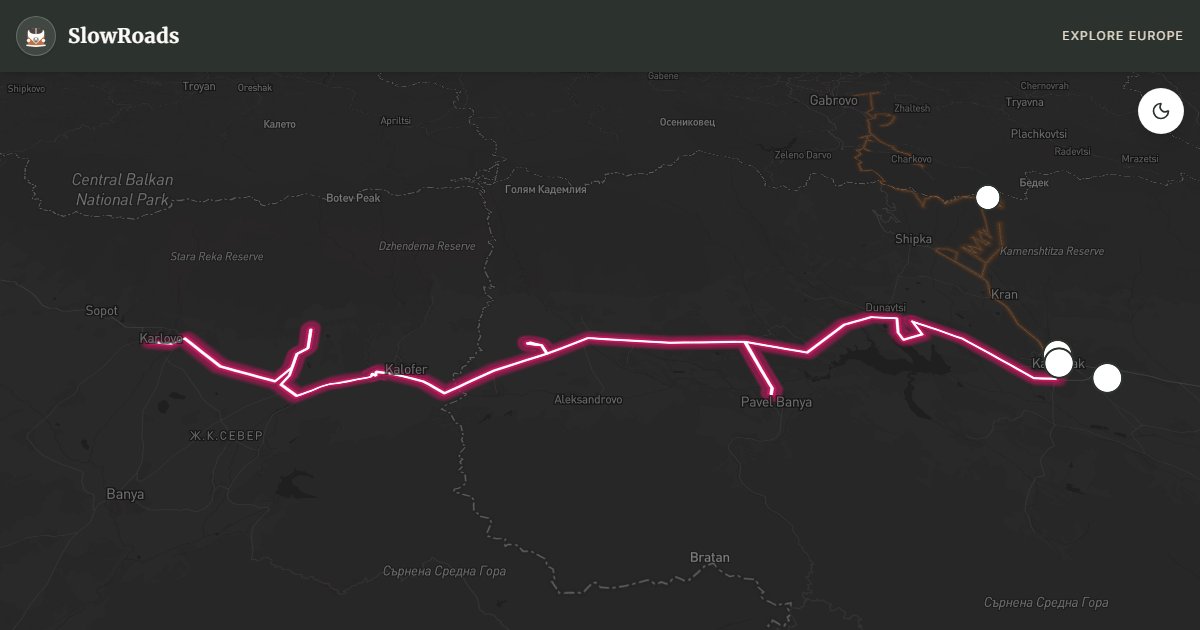
The Rose Valley of Bulgaria produces roughly half the world's rose attar from Rosa damascena petals hand-picked at dawn during a three-week window in late May — and the valley roads connecting Karlovo, Kazanlak, and the Thracian tomb fields offer one of Europe's most sensory slow drives. This roughly 77-kilometre route through the Sredna Gora foothills combines perfume agriculture, UNESCO burial art, and Revival-era architecture on gentle gradients that any classic or low-power campervan handles without breaking a sweat, making it the ideal rest day between Shipka's mountain grades and the Rila loop's long distances.
Karlovo anchors the western end — birthplace of revolutionary poet Hristo Botev and a smaller rose-distillation centre with fewer tourists than Kazanlak. The town's Revival houses climb a valley slope; the local museum explains how Ottoman-era landowners introduced damascena roses from the Middle East in the seventeenth century and why the valley's microclimate — hot days, cool nights, limestone soil — produces the world's highest-quality attar. Fuel and supplies here before the valley traverse.
The road east toward Kazanlak passes through working rose plantations that bloom into pink oceans in late May. During Rose Festival week (first weekend of June), villagers in costume perform rose-picking rituals, distilleries open for demonstrations, and the air carries perfume so intense that van windows down becomes mandatory. Outside festival season, the fields remain photogenic through June and the distilleries operate year-round with less ceremony.
Kazanlak is the valley capital — Rose Museum, Thracian Tomb UNESCO site (a beehive burial chamber with Hellenistic frescoes depicting funeral feasts), and a pedestrian centre with restaurants serving banitsa and shops selling attar in tiny crystal bottles. The tomb replica next to the original protects the fragile paintings while allowing visitor access; allow ninety minutes for museum and tomb combined.
A detour west to Koprivshtitsa rewards an extra half-day — a preserved Revival village where the 1876 April Uprising against Ottoman rule began, now a living museum of colourful timber houses with overhanging upper floors and ethnographic collections. The road from Karlovo climbs modestly into the Sredna Gora but stays below 6% gradient throughout.
Optional north detour to Buzludzha peak adds the surreal communist monument visible from the valley floor — a striking contrast between ancient perfume trade and twentieth-century ideology. The Thracian Valley also holds the Valley of the Thracian Kings — a cluster of mound tombs near Shipka and Kazanlak where archaeologists continue excavating gold masks and bronze horse harnesses from the fourth century BC. Several mounds open to visitors with replica interiors; combine with the Kazanlak tomb for a full afternoon of pre-Roman Balkan history.
For classic campervan drivers, the Rose Valley is about timing: late May for harvest spectacle when pickers fill wicker baskets at dawn, September for golden light and empty fields after distillation ends, and avoiding August heat when valley temperatures exceed 35°C with limited shade at roadside stops. The driving itself is effortless — use this route to service the van, rest overheated engines after Shipka, and stock up on attar, honey, and white cheese from roadside vendors. Camp at Kazanlak municipal sites, Karlovo guesthouses, or Koprivshtitsa family pensions where Revival-era rooms cost less than coastal equivalents. LPG available in both valley towns. Pair with Shipka Pass immediately north for a complete central Bulgaria history-and-landscape pairing.
Frequently Asked Questions
Points of Interest
Thracian Tomb of Kazanlak
Monument
UNESCO beehive tomb with Hellenistic frescoes — the finest painted Thracian burial chamber in the Balkans.
Rose Museum & Distillery
Monument
Exhibits on attar production since the Ottoman era — live distillation demonstrations during Rose Festival week.
Koprivshtitsa Old Town
Town
A museum-village of Bulgarian Revival architecture — colourful timber houses and April Uprising history.
Tyulbeto Rose Fields
Nature
Working Rosa damascena plantations east of Kazanlak — dawn harvesting during festival season fills the air with perfume.
Buzludzha Peak View
Monument
Optional detour north to the communist monument visible from the Rose Valley — surreal contrast to rose fields below.
Route Highlights
Route Information
Navigation
* Supported by HERE Technologies, headquartered in Amsterdam, Europe. Precise routing through all waypoints.
* Waze only navigates to the starting point. Use Google Maps for the full scenic route.
Offline GPS Navigation
Download the GPX route file to navigate offline using your favorite GPS device or app (Garmin, TomTom, OsmAnd, Gaia GPS).
Ask Copilot (AI Travel Guide)
Hello! I am your SlowRoads Copilot. I know the Rose Valley & Thracian Tomb Route intimately. Ask me about scenic viewpoints, local history, hidden culinary gems, or the best camper spots along the way!