About This Route
Drive the Silver Road through Saxony’s Ore Mountains UNESCO mining region: Freiberg, Annaberg-Buchholz, and living Christmas craft workshops on about 143 km of highland B-roads. Sustained climbs and cool ridge air ask older and low-power campervans for low gears, coolant checks, and unhurried staging between mining towns. Winter craft markets are magical but roads can ice; late spring to autumn is safer for loaded vans. Use Stellplätze in mining towns rather than wild overnighting. Expect narrow historic centres — park outside and walk to museums and workshops.
Detailed Route Guide
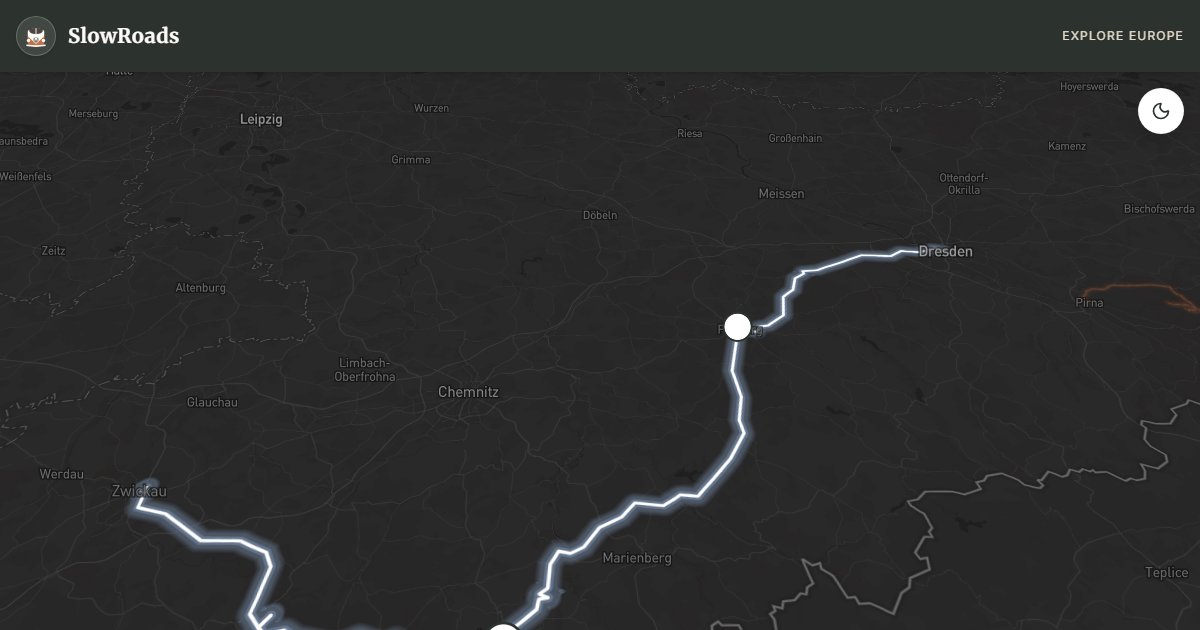
The Silver Road (Silberstraße) winds through the Ore Mountains (Erzgebirge) of Saxony, a 143-kilometre route connecting towns that were once among the wealthiest places in the Holy Roman Empire — their fortunes built not on agriculture but on silver, tin, and cobalt extracted from the mountains that give the region its name. Today the Erzgebirge is a UNESCO World Heritage Site, recognised not only for its mining heritage but for the extraordinary cultural traditions — Christmas pyramids, nutcrackers, smokers, and intricate lacework — that developed during the centuries when miners' families needed winter income.
The route begins in Zwickau, a city best known today as the birthplace of Robert Schumann and the location of the Horch-Werk automobile factory where the legendary Auto Union racing cars were built in the 1930s. The August Horch Museum traces the full story of Saxony's automotive legacy — Audi, Wanderer, DKW, and Horch formed the four-ring Auto Union that would become today's Audi. From Zwickau, the Silver Road climbs steadily into the mountains, passing through Aue and reaching Annaberg-Buchholz at 570 metres altitude — one of the most significant silver mining towns of the 16th century. The late Gothic St. Anne's Church here, completed in 1525, was built from the profits of the silver rush and decorated with scenes of mining life: miners with their lamps, geological surveys, smelting operations rendered in stone with startling realism.
Freiberg, the route's eastern terminus, sits in the Mulde Valley and was the seat of the Saxony mining administration for centuries. Its cathedral contains the most important example of Romanesque/early Gothic sculpture in Saxony — the Golden Gate (Goldene Pforte), a portal of extraordinary refinement. The city's mining academy, founded in 1765, was the first mining academy in the world and trained engineers who spread Saxony's mining expertise across Europe and the Americas.
The Christmas traditions of the Erzgebirge are not a marketing invention — they developed organically as winter crafts during the centuries when miners spent the off-season carving wood by candlelight. The smoker figure (Räuchermann), the nutcracker, the pyramid with candle-powered rotating carousel, and the Schwibbogen (the curved wooden arch of lights) all originated here and are still produced in family workshops throughout the region. The best time to see them in context is Advent, when every market, window, and Stube glows with them. But the workshops are open year-round and welcome visitors who want to watch the carving and painting process.
For classic and low-power campervans: the Silver Road involves significant climbing from Zwickau up to Annaberg-Buchholz and Oberwiesenthal (near the Czech border). Gradients are not extreme by alpine standards but are sustained — plan for first and second gear use on the mountain approaches. The descent into the Mulde Valley at Freiberg is steep in places. Road surfaces are generally good. The region sees little tourist traffic outside summer and Christmas markets, making parking and fuel stops straightforward year-round.
Allow two to three days so you can visit a working workshop in Seiffen, walk a stretch of the Kammweg ridge path, and see Freiberg’s cathedral without rushing. Fuel and Stellplätze are easier to find in the valley towns than on the high ridge — fill up before climbing toward Oberwiesenthal. Advent is magical but icy; summer offers cooler air than the Saxon lowlands and quieter roads than Bavaria’s alpine corridors.
Frequently Asked Questions
Points of Interest
St. Anne's Church
Monument
Freudenstein Castle
Castle
Route Highlights
Route Information
Navigation
* Supported by HERE Technologies, headquartered in Amsterdam, Europe. Precise routing through all waypoints.
* Waze only navigates to the starting point. Use Google Maps for the full scenic route.
Offline GPS Navigation
Download the GPX route file to navigate offline using your favorite GPS device or app (Garmin, TomTom, OsmAnd, Gaia GPS).
Ask Copilot (AI Travel Guide)
Hello! I am your SlowRoads Copilot. I know the Silver Road intimately. Ask me about scenic viewpoints, local history, hidden culinary gems, or the best camper spots along the way!