About This Route
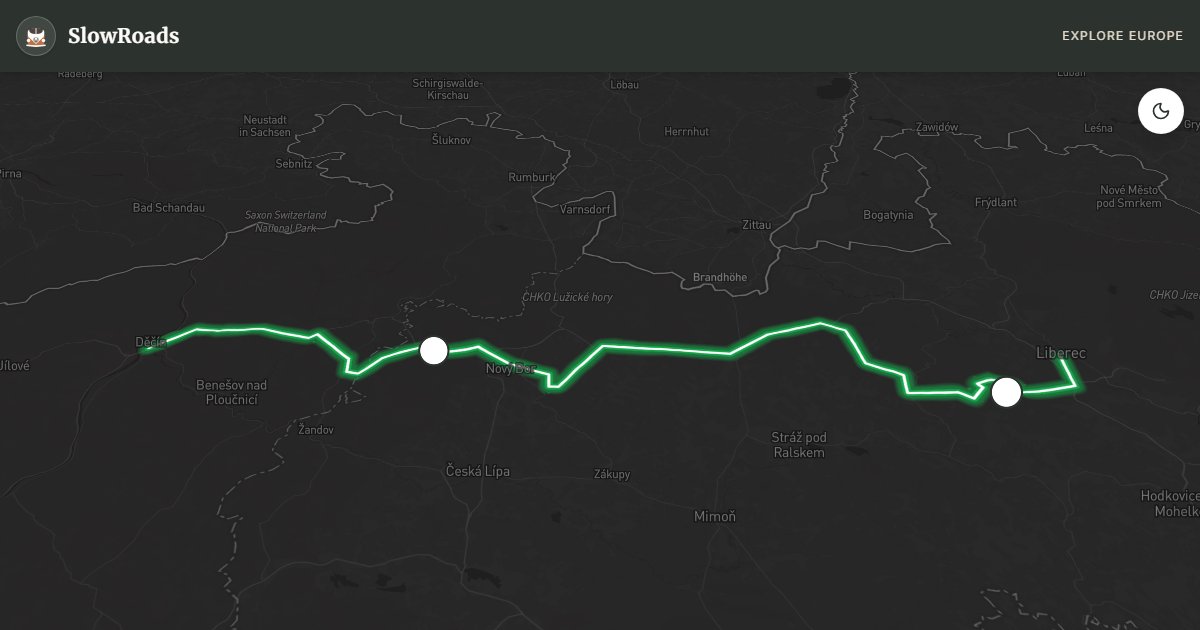
Explore the Lusatian Mountains from Děčín toward Liberec — about 75 km of gentle volcanic hills on the Czech–Saxon border for classic campervans. Umgebindehäuser timber-frame villages, Panská skála's basalt organ pipes, and views toward Ještěd's hyperboloid tower define a quiet borderland drive. Grades stay modest compared with Krkonoše; older low-power vans manage with patience and pull-ins. Autokemp overnight only. Spring blossom and autumn colour beat midsummer coach traffic. Fill fuel in Děčín or Liberec before quieter forest stretches, and expect narrow village cores — park outside and walk the stone organ.
Detailed Route Guide
The Lusatian Mountains route explores one of Central Europe's most quietly compelling border regions — the hilly landscape where Czechia meets the German state of Saxony, a territory shaped by coal, weaving, and a unique vernacular architecture found nowhere else on earth. The defining feature of this region is the Umgebindehaus — a hybrid building tradition that arose from the fusion of two separate construction methods: the Central European log cabin tradition and the West German timber-frame (Fachwerk) tradition. The result is a building type where a log cabin sits inside a timber-frame outer shell, with the two structures quite literally freestanding from each other. The Oberlausitz region has the highest concentration of these remarkable buildings, and the route winds past hundreds of them in villages that have barely changed in 200 years.
The route threads through the Lusatian Mountains (Lužické hory) — a range of gentle, mostly forested volcanic hills that reach about 793 metres at their highest. The hills have the rounded, comfortable character of old, deeply eroded volcanic cones rather than the savage drama of truly high mountains, and the roads that cross them are correspondingly relaxed and enjoyable to drive. One of the geological highlights is Panská skála near Kamenický Šenov — a formation of hexagonal basalt columns rising from a hillside like a giant pipe organ, similar to the Giant's Causeway in Northern Ireland but formed by the same process of slow volcanic cooling. The columns are accessible via a short walk from a roadside car park and are genuinely spectacular.
For a classic / low-power campervan crew, this is near-ideal territory. The gradients are gentle, the roads are generally quiet (especially off the main connecting roads), and the villages reward slow driving and random stopping. The border crossing points between Czechia and Germany are open and unguarded, so the route can easily extend into the Saxon Swiss National Park (Sächsische Schweiz) on the German side — a landscape of dramatic sandstone towers and gorges that is one of the most extraordinary in Central Europe. Towns like Šluknov, Jiřetín pod Jedlovou, and Rybniště have well-preserved historic centres with examples of the Umgebindehaus architecture at almost every turn.
The Lusatian Mountains route is best driven in late spring (May to June) when the forests are at their most intensely green and wildflowers line the road verges, or in autumn (September to October) when the beech forests turn amber and gold. Summer is pleasant but can bring some visitor pressure at the most popular spots. Winter closes some mountain roads and conditions can be challenging, but the snow-covered timber-frame villages have an almost fairy-tale quality that rewards adventurous cold-weather travellers.
Extend into Saxon Switzerland only if you want a sandstone gorge day — Schengen crossings are open, but overnight still belongs on campsites, not forest lay-bys. Česká Lípa is the practical service town; fill fuel before quieter border villages. Gradients stay modest compared with Krkonoše, so cooling stress is low — the challenge is narrow village streets lined with Umgebindehäuser, where patience and passing places matter more than horsepower.
May–June wildflowers and September–October beech colour are the best windows. Winter snow on higher lanes is possible; check conditions before committing a loaded classic camper. Panská skála needs only a short walk from roadside parking — allow half an hour. Ještěd’s hyperboloid tower near Liberec is a worthwhile nearby detour if you want a modern landmark after a day of timber-frame villages.
Frequently Asked Questions
Points of Interest
Panská skála (Basalt Pipes)
Nature
Mystical hexagonal basalt columns known as the 'Stone Organ', formed by volcanic activity 30 million years ago.
Ještěd Tower (nearby)
Monument
An award-winning futuristic hotel and transmitter tower shaped like a hyperboloid on top of Mount Ještěd.
Route Highlights
Route Information
Navigation
* Supported by HERE Technologies, headquartered in Amsterdam, Europe. Precise routing through all waypoints.
* Waze only navigates to the starting point. Use Google Maps for the full scenic route.
Offline GPS Navigation
Download the GPX route file to navigate offline using your favorite GPS device or app (Garmin, TomTom, OsmAnd, Gaia GPS).
Ask Copilot (AI Travel Guide)
Hello! I am your SlowRoads Copilot. I know the Lusatian Mountains & Timber Houses intimately. Ask me about scenic viewpoints, local history, hidden culinary gems, or the best camper spots along the way!