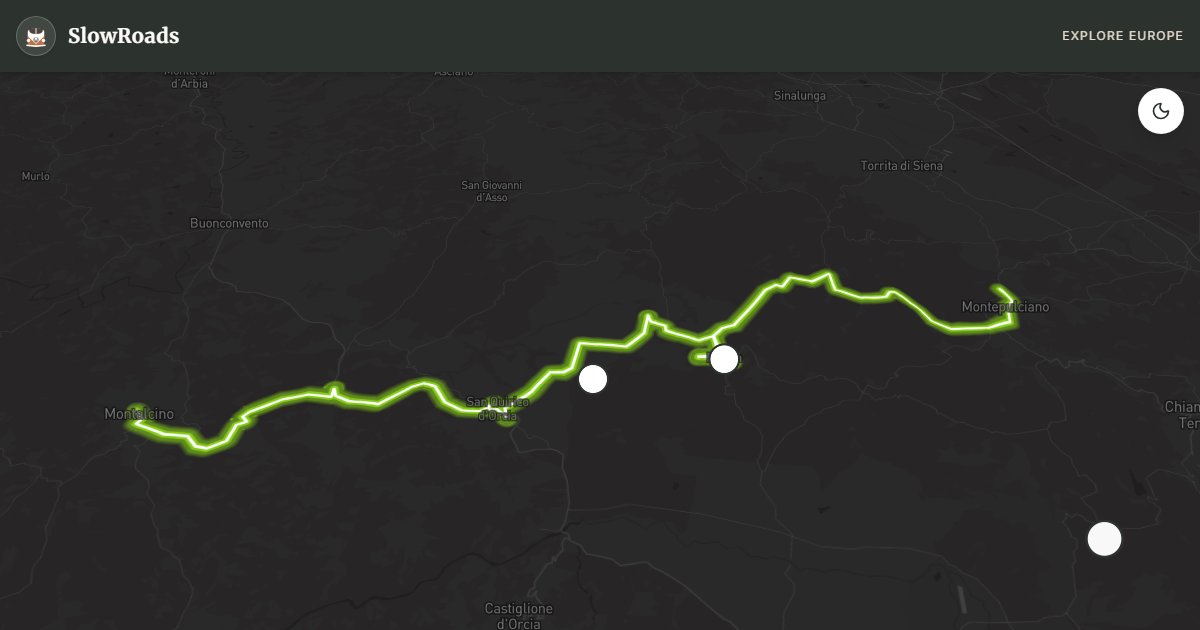
About This Route
Cruise UNESCO Val d'Orcia between Montepulciano and Montalcino — cypress avenues at La Foce, Renaissance Pienza, Vitaleta Chapel, and Brunello country on gentle SP146 hills. Classic and low-power campervans thrive here: soft grades, wide provincial roads, and golden-hour light that changes every hour. Park outside hill-town ZTLs and walk in; overnight at agriturismi with pitches rather than assuming farm-track camping is fine. Carry cash for cellar doors and farm lunches. Late April–June greens or October vines beat crowded August afternoons in Pienza and Montalcino.
Detailed Route Guide
The Val d'Orcia is the Tuscany of the imagination made real — a landscape so perfectly composed that it looks less like a natural valley and more like a Renaissance painting brought to three dimensions. Lying in the southern part of Tuscany between Montepulciano and Montalcino, it was shaped over centuries by human cultivation into a terrain of sweeping clay hills, isolated stone farmhouses (poderi), avenue after avenue of cypress trees, and vineyards that produce some of Italy's most celebrated wines. The entire area was inscribed as a UNESCO World Heritage Site in 2004, not for any single monument but for the landscape itself — for what the nomination called "an outstanding example of how the natural landscape was redesigned in the Renaissance period to reflect the ideals of good governance and to create an aesthetically pleasing picture."
The 39-kilometre route between Montepulciano and Montalcino concentrates the very best of this landscape. Montepulciano itself is a long, narrow hilltop town of extraordinary architectural coherence, its streets paved in tufo and its cellars full of Vino Nobile — one of Italy's great red wines. The road then descends through the Val d'Orcia proper, passing the turning for La Foce, a private estate whose cypress-lined driveway has become the single most photographed image in all of Tuscany. The walled Renaissance town of Pienza — created in the 1460s by Pope Pius II as his ideal city — is the midpoint, and its main square, the Piazza Pio II, is a jewel of early Renaissance urban design. Montalcino at the end of the route is the home of Brunello, among the most prestigious and long-lived red wines in the world.
A classic or low-power campervan is in its natural element on these roads. The terrain is gently undulating rather than steep, and the famous SP146 Cassia road through the heart of the Val d'Orcia is wide, smooth, and traffic-light. You can drive with the windows down, the engine barely working, and stop anywhere: by a cypress avenue, at a roadside wine estate, or simply on a verge overlooking the rolling hills. The light changes constantly throughout the day, and the landscape looks entirely different at sunrise, at midday, and in the golden hour before sunset. Plan at least one overnight stop — the experience of being in the valley at dusk when the day visitors have left is entirely different from the midday scene.
Spring (April to June) is the most famous time for the Val d'Orcia: the hills are vivid green, the wildflowers are blooming, and the light is clear and soft. October is equally beautiful as the vine leaves turn gold and the air cools. August is warm but can bring crowds to Pienza and Montalcino in the afternoons. Whatever time you visit, resist the temptation to rush through: the Val d'Orcia rewards those who slow to its pace, stop without reason, and simply look.
Van logistics here are gentle but ZTL rules are not. Park outside the walls of Pienza, Montepulciano, and Montalcino and walk in — cameras fine unauthorised entries. Agriturismi with camper pitches are the most reliable overnight option inside the UNESCO landscape; wild camping on farm tracks is not a safe assumption. Midday heat in July–August is hard on older engines even on mild gradients, so drive early and late. Keep cash for small wine estates and farm lunches. The SP146 and linking provincial roads are the scenic spine — avoid the temptation to “save time” on faster corridors that skip the cypress ridges you came for.
Frequently Asked Questions
Points of Interest
Cypress Avenue (La Foce)
Nature
Pienza Historic Center
Town
Vitaleta Chapel
Monument
Route Highlights
Nearby Scenic Drives
Route Information
Navigation
* Supported by HERE Technologies, headquartered in Amsterdam, Europe. Precise routing through all waypoints.
* Waze only navigates to the starting point. Use Google Maps for the full scenic route.
Offline GPS Navigation
Download the GPX route file to navigate offline using your favorite GPS device or app (Garmin, TomTom, OsmAnd, Gaia GPS).