About This Route
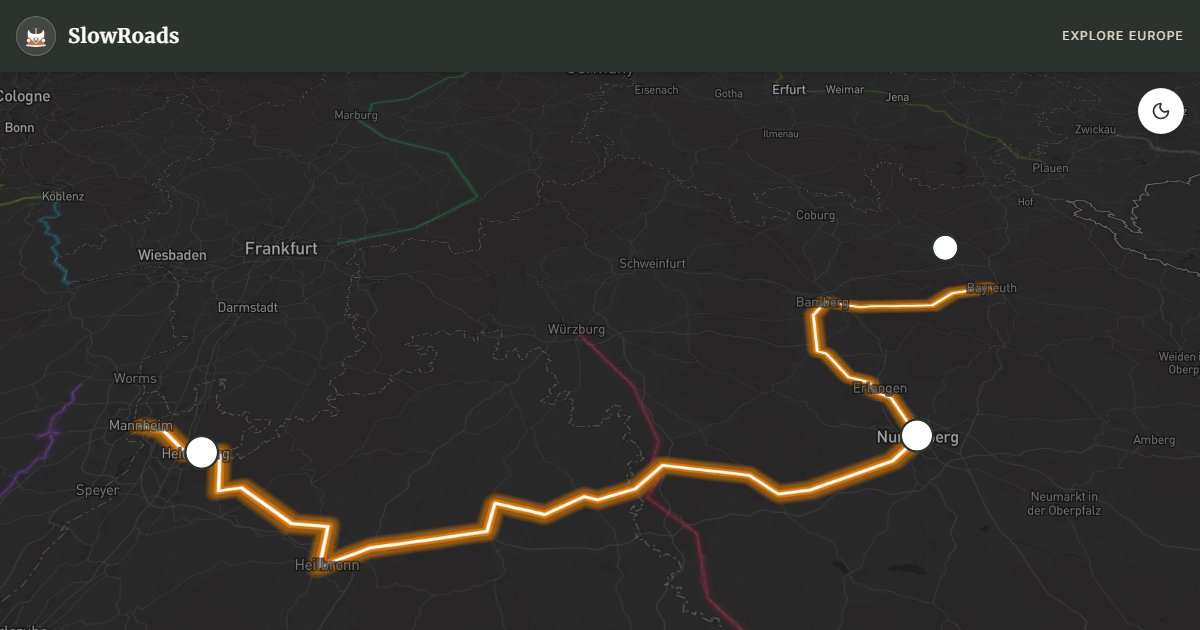
Follow the Castle Road from Mannheim past Heidelberg and the Neckar Valley to Rothenburg, Nuremberg, and Bayreuth — over 70 castles on one historic drive of about 342 km. Choose a western or eastern segment rather than rushing the whole corridor in a loaded classic campervan. River valleys stay mostly gentle; historic centres demand outer parking and height awareness. Stellplätze are widespread; wild camping is generally not allowed. Spring and autumn beat midsummer coach traffic at Heidelberg and Rothenburg. No national vignette — plan fuel and overnight stops as stages, not a single marathon day.
Detailed Route Guide
The Castle Road (Burgenstraße) is one of Germany's great historical drives: a 342-kilometre route connecting over 70 castles, palaces, and fortified residences from Mannheim on the Rhine to Bayreuth in Franconia, passing through the Neckar Valley, the Hohenlohe plateau, Rothenburg ob der Tauber, Nuremberg, and the Bavarian Franken region. For anyone with an interest in European medieval history, this is the definitive German route — a continuous thread of fortified architecture spanning 1,500 years from Roman foundations to 19th-century neo-Gothic reconstructions.
The route begins in Mannheim, which despite its baroque grid-plan city layout has no medieval castle of its own (it was largely destroyed in the Thirty Years' War and rebuilt from scratch). But the drive east along the Neckar River quickly delivers: Heidelberg, with its great castle ruin overlooking the town and river, is one of the most visited sites in Germany and deservedly so. The castle (Heidelberger Schloss) was among the largest and most significant Renaissance palaces north of the Alps before French forces demolished it in 1689 and again in 1693. The ruins — massive walls of red sandstone half-covered in ivy, towers blown apart by French gunpowder, courtyards open to the sky — have a romantic power that complete castles often lack. The old town below, with its Hauptstraße pedestrian zone and the university founded in 1386 (Germany's oldest), could easily absorb a full day.
Continuing east along the Neckar through the narrow Odenwald valleys, the route passes a succession of smaller but individually significant castles: Bad Wimpfen (a ridge-top former imperial palace now largely in ruins but with spectacular valley views), and Horneck Castle at Gundelsheim. The road then climbs onto the Hohenlohe plateau — a gently rolling agricultural landscape that produced the Hohenlohe princes who kept this corner of Germany independent until Napoleon dissolved the Holy Roman Empire in 1806. Their ancestral residences (Weikersheim Palace, Langenburg Castle perched above a river valley) are among the finest baroque manor houses in Germany.
Rothenburg ob der Tauber, where the Castle Road intersects with the Romantic Road, is the route's medieval apex — the same extraordinary walled town encountered on the other route. Continuing north and east through Ansbach (home to the Margrave's Palace) and into the city of Nuremberg: Germany's unofficial self-styled 'capital of the Middle Ages'. The Imperial Castle (Kaiserburg) above the old town was the preferred seat of the Holy Roman Emperors for centuries; the nearby Germanic National Museum holds the largest collection of German cultural history in the world. Nuremberg was also where the Nazi party held its annual rallies from 1933-38, and the Documentation Centre at the preserved rally grounds provides one of Germany's most sobering historical encounters.
The route ends in Bayreuth, a modest Franconian town elevated to operatic significance by Richard Wagner, who built the Festspielhaus here in 1876 to perform his Ring cycle in perfect acoustic conditions. The annual Wagner festival (July-August) draws audiences from around the world and has a 10-year waiting list for tickets. The Margravial Opera House, built in 1748 and a UNESCO World Heritage Site, is the finest baroque theatre in Germany still in its original condition.
For van drivers, the Castle Road divides naturally into two sections. The first (Mannheim to Rothenburg) follows the relatively flat Neckar Valley with some climbing onto the Hohenlohe plateau. The second (Rothenburg to Bayreuth) crosses the Frankenhöhe hills with gentle gradients. Neither section presents challenges for low-powered vehicles. The 342km total length means this is a route for the dedicated — allow a full week minimum to do it justice.
Frequently Asked Questions
Points of Interest
Heidelberg Castle
Castle
Imperial Castle Nuremberg
Castle
Plassenburg
Castle
Route Highlights
Route Information
Navigation
* Supported by HERE Technologies, headquartered in Amsterdam, Europe. Precise routing through all waypoints.
* Waze only navigates to the starting point. Use Google Maps for the full scenic route.
Offline GPS Navigation
Download the GPX route file to navigate offline using your favorite GPS device or app (Garmin, TomTom, OsmAnd, Gaia GPS).