About This Route
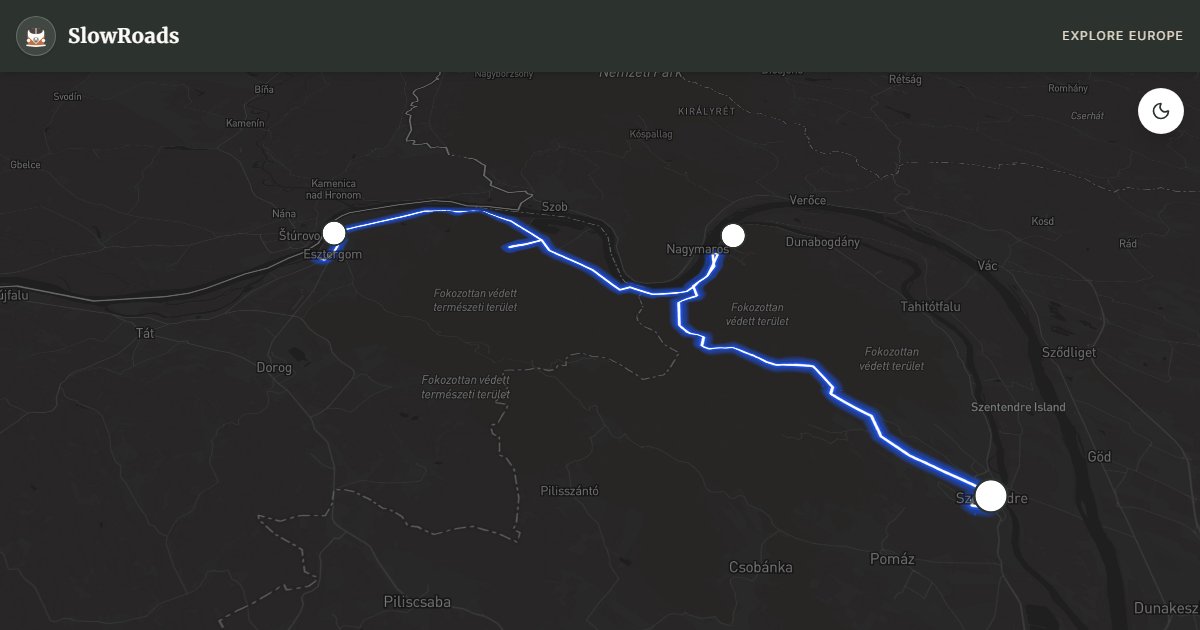
Drive the Danube Bend on Road 11 from Szentendre to Esztergom — about 49 km of flat riverside asphalt ideal for older and low-power campervans near Budapest. Artists' lanes in Szentendre, Visegrád's citadel above the narrowest bend, and Esztergom Basilica on its limestone bluff pack major heritage into one easy day. Leave the van in town lots for the castle climb or shuttle. Official campsites only; riverbank wild camping is not legal. Weekend Budapest traffic is the main friction — midweek mornings stay calmer. Optional ferry Visegrád–Nagymaros or the Mária Valéria Bridge into Slovakia adds variety without steep grades.
Detailed Route Guide
Where the Danube makes its great dramatic bend southward through the mountains of the Börzsöny and Pilis ranges, it has shaped one of Hungary's richest historical corridors. The Danube Bend (Dunakanyar) is where the river, flowing broadly east across the Pannonian Plain, is suddenly squeezed into a narrow gorge and forced to turn almost directly south — a geographic spectacle visible clearly on any map of Central Europe. This 49-kilometre route from Szentendre to Esztergom follows the river's western bank, connecting three towns that are among the most historically significant in the entire Carpathian Basin. It is a rare combination: major cultural monuments within sight of each other, yet connected by a riverside road so flat and easy that even the oldest air-cooled engine will manage it without protest.
Szentendre is the gateway — a town of church towers and cobblestoned lanes that has attracted Hungarian artists since the early 20th century. Its Serbian Orthodox churches, baroque architecture, and pedestrian-only old quarter deserve at least half a day. The nearby Open-Air Ethnographic Museum (Skanzen) at Szentendrei Skanzen is one of Europe's largest, with traditional farmsteads relocated from across Hungary. Continuing north, the road hugs the Danube bank through small villages before arriving at Visegrád, where a medieval Royal Palace once rivalled the courts of Western Europe and a dramatic hilltop citadel watches over the narrowest point of the bend. Solomon's Tower and the reconstructed Renaissance palace gardens are highlights. The finale is Esztergom — Hungary's religious capital, dominated by its massive Basilica (the largest church in Hungary), which sits on a limestone bluff above the river with Slovakia visible on the far bank.
For a classic / low-power campervan, this route is as stress-free as it gets. The riverside Road 11 is flat, well-maintained, and mostly two-lane with good overtaking opportunities. Parking is straightforward in all three towns, with dedicated lots near the main sights. The only decision is whether to combine the route with the eastern bank via ferry: a car ferry runs Visegrád–Nagymaros, while the Mária Valéria Bridge links Esztergom with Štúrovo (Slovakia) — combining both banks adds tremendous variety. Keep an eye on weekend traffic from Budapest — the area is a popular day-trip destination and the road can get busy on sunny Saturdays from spring through autumn.
The Danube Bend is a true four-season destination. Spring brings dramatic flooding views as snowmelt swells the river. Summer is peak season but manageable — the river breezes keep temperatures pleasant and the outdoor terraces of Szentendre are lively. Autumn is spectacular: the Börzsöny hills across the river turn fiery red and gold, and the light on the water is extraordinary. Winter is quiet and atmospheric, especially with snow on the Visegrád citadel, but check opening times for palaces and museums as they often reduce hours significantly between November and March.
Practical tip for classic campervans: Road 11 is flat and vignette-free. Use official campsites in Szentendre, Visegrád or Esztergom — do not plan on riverbank wild camping. Weekend Budapest traffic is the main friction; midweek mornings are calmer. The citadel climb is on foot or shuttle — leave the van in town lots.
Combine the west bank with the Visegrád–Nagymaros ferry when running, or cross to Slovakia via the Mária Valéria Bridge for a short Schengen hop. Carry forint cash for small sites and fish restaurants.
Frequently Asked Questions
Points of Interest
Visegrád High Castle
Castle
Hilltop citadel above the narrowest point of the Danube Bend — finest viewpoint; leave the van in town and climb or take the shuttle.
Esztergom Basilica
Monument
Hungary's largest church on a limestone bluff above the Danube, with Slovakia visible across the Mária Valéria Bridge.
Szentendre Old Town
Town
Artists' town of church towers and cobbled lanes 20 km north of Budapest — park outside the pedestrian core.
Route Highlights
Route Information
Navigation
* Supported by HERE Technologies, headquartered in Amsterdam, Europe. Precise routing through all waypoints.
* Waze only navigates to the starting point. Use Google Maps for the full scenic route.
Offline GPS Navigation
Download the GPX route file to navigate offline using your favorite GPS device or app (Garmin, TomTom, OsmAnd, Gaia GPS).
Ask Copilot (AI Travel Guide)
Hello! I am your SlowRoads Copilot. I know the Danube Bend Heritage intimately. Ask me about scenic viewpoints, local history, hidden culinary gems, or the best camper spots along the way!