About This Route
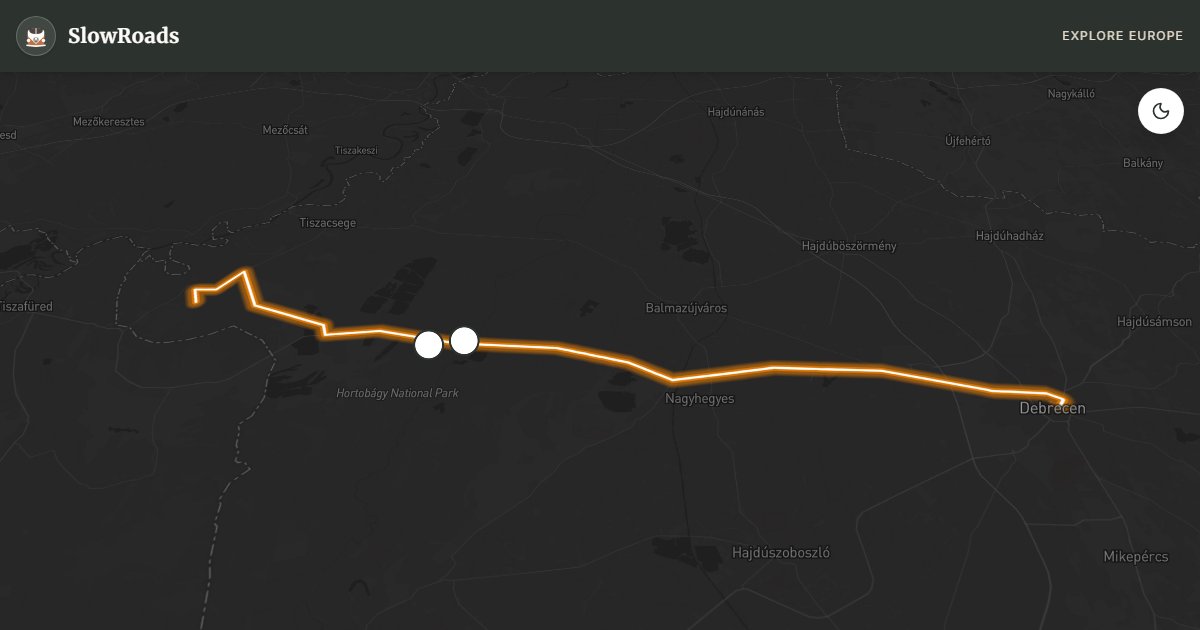
Cross the Hortobágy puszta on Road 33 from Tiszafüred toward Debrecen — about 63 km of zero-gradient steppe ideal for classic and low-power campervans. Hungary's great grassland opens to the horizon: Nine-Hole Bridge at Hortobágy village, grey cattle and Racka sheep, and autumn crane migration. Heat and wind on the open plain stress cooling in July–August stop-and-go — carry water and watch the temperature gauge. Overnight only at the park campsite or Debrecen services; the open puszta is not for wild camping. e-matrica is for motorways. October crane season and spring birdlife reward unhurried days under a huge sky.
Detailed Route Guide
The Hortobágy is a landscape that operates on a different scale from almost anywhere else in Europe. This vast steppe — the largest continuous natural grassland on the continent west of the Caspian Sea — stretches to the horizon in every direction, unbroken by hedge, hill, or house. The sky here is enormous, the light is extraordinary, and the silence is profound. It is a UNESCO World Heritage Site and Hungary's oldest national park, established in 1973, protecting a remnant of the ancient Pannonian steppe that once covered the entire Carpathian Basin before centuries of agricultural development reduced it to this precious 800-square-kilometre enclave. This 63-kilometre route from Tiszafüred to Debrecen crosses the heart of this unique landscape on road 33 — the straightest, flattest, most meditative road in Hungary, possibly in Central Europe.
The route's central landmark is the Nine-Hole Bridge (Kilenclyukú híd) at Hortobágy village, Hungary's longest stone bridge and one of its most recognisable images. Built in 1833 over the Hortobágy stream, its nine arches reflect in the water during spring floods, creating an almost perfectly symmetrical image. The bridge marks the traditional heart of puszta life: herdsmen (gulyás, csikós, juhász) still drive grey cattle, Racka sheep, and Hungarian horses across this plain using methods unchanged for centuries. The Hortobágy National Park has made considerable efforts to preserve this pastoral heritage — horse shows featuring spectacular csikós (mounted herder) whipcracking and stunt riding take place regularly in summer near the bridge. The sweep wells (gémeskút) scattered across the plain are another iconic image, their long wooden arms silhouetted against the sunset.
For older and low-power campervan drivers, the Hortobágy route is a pure joy. The gradient is so close to zero that it is genuinely imperceptible — the engine barely registers a load change for the entire 63 kilometres. The roads are wide, well-maintained, and carry very little traffic compared to the urban areas. The greatest driving pleasure here is simply opening the windows, setting a comfortable speed of 70–80 km/h, and watching the steppe slide by. The main practical concern is fuel: there is a petrol station in Hortobágy village, but otherwise the nearest options are Tiszafüred (start) and Debrecen (end). Also note that summer afternoons can be extremely hot on the open plain — 36–40°C is common in July. Ensure your cooling system is in good order.
Birdwatching is the activity that brings naturalists from across Europe to the Hortobágy. The wetlands — the Hortobágy Fish Ponds (Halastó) just south of the main road — host one of Europe's greatest crane migrations in October, when hundreds of thousands of common cranes gather to roost before continuing south. White storks nest in every village in spring. Great bustards, marsh harriers, and the endangered red-footed falcon breed here. Even for non-birdwatchers, the spectacle of the crane migration is unforgettable. Spring (April–May) is also magnificent when the puszta flowers and the first cuckoos arrive. Summer nights offer exceptional stargazing — the dark skies over the puszta are among Hungary's finest.
Practical tip: Road 33 is vignette-free and essentially flat — ideal for classic low-power campervans. The stressor is heat and empty distance: fill in Tiszafüred, Hortobágy village or Debrecen, carry water, and watch coolant on 36–40°C July afternoons. Overnight only at official sites (Hortobágy village, Tiszafüred, Debrecen outskirts) — wild camping in the national park is prohibited.
October crane roost flights at the fish ponds are the wildlife highlight; arrive mid-afternoon for sunset skeins. Sweep wells and grey cattle herds reward slow pull-offs in marked areas only.
Frequently Asked Questions
Points of Interest
Nine-holed Bridge
Monument
Hungary's longest stone arch bridge (1833) at Hortobágy village — iconic nine arches over the puszta stream.
Puszta Wildlife Park
Nature
National-park area near Hortobágy for grey cattle, Racka sheep and traditional herding landscapes — stay on marked routes.
Route Highlights
Route Information
Navigation
* Supported by HERE Technologies, headquartered in Amsterdam, Europe. Precise routing through all waypoints.
* Waze only navigates to the starting point. Use Google Maps for the full scenic route.
Offline GPS Navigation
Download the GPX route file to navigate offline using your favorite GPS device or app (Garmin, TomTom, OsmAnd, Gaia GPS).
Ask Copilot (AI Travel Guide)
Hello! I am your SlowRoads Copilot. I know the Hortobágy (The Puszta) intimately. Ask me about scenic viewpoints, local history, hidden culinary gems, or the best camper spots along the way!