About This Route
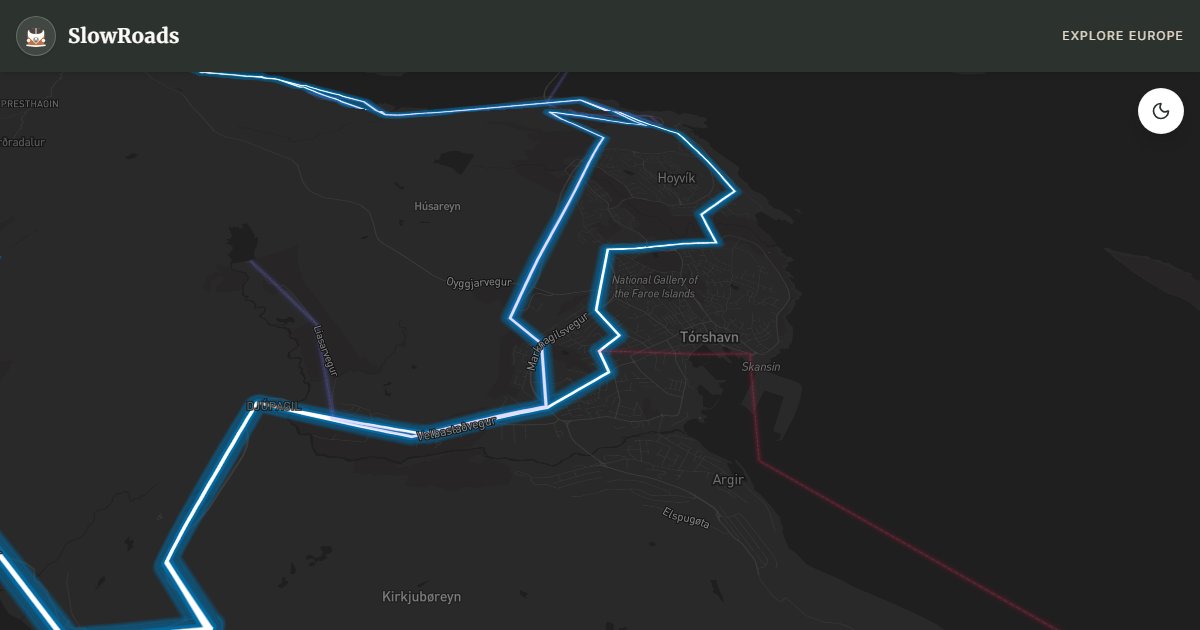
The classic Streymoy–Eysturoy–Vágar circuit from Tórshavn links the Faroes' main islands via subsea tunnels and mountain passes — turf-roof villages, fjord views, and Atlantic light in one slow day. Single-lane tunnels with passing bays demand patience; pay the Vágatunnilin toll and keep headlights on underground. Classic and low-power campervans suit the pace if you yield early and never rush blind corners. Atlantic gusts can exceed 30 m/s on exposed ridges; ferry and mountain roads close under storm warnings. Use campsites near Tórshavn or Vágar — wild overnighting is not the Faroese norm.
Detailed Route Guide
The Faroe Islands main loop is the archipelago's essential introduction — a roughly 117-kilometre circuit from Tórshavn through subsea tunnels, single-lane mountain roads, and grass-roof villages that compress an entire North Atlantic nation into two or three days of slow van travel. For classic and low-power campervan drivers, the Faroes present a unique mechanical profile: no extreme gradients, but tunnels, wind, and weather govern every decision more than horsepower ever will.
Tórshavn anchors the loop — one of the world's smallest capitals, with turf-roof parliament, harbour cafés, and the best van services in the archipelago (fuel, provisions, ferry bookings). From Tórshavn, Route 50 crosses to Vágar via the Vágatunnilin subsea tunnel (toll payable by card at the booth — height limit 4.2 metres, fine for all vans). The tunnel is two-lane and straightforward; the challenge comes on Vágar's wind-exposed coastal road where gusts can push a high-sided van sideways without warning.
The loop continues north to Streymoy's Saksun lagoon — a tidal amphitheatre of cliffs and grass-roof farmhouses reached via a single-lane road with passing bays. Van etiquette in Faroese tunnels and narrow roads: pull into the nearest passing place for oncoming traffic, headlights on in all tunnels, and never block a passing bay overnight. The Eysturoyartunnilin subsea tunnel (opened 2020) connects via the world's first undersea roundabout — two lanes, well-lit, but the approach roads on Eysturoy climb exposed ridges where wind speeds regularly exceed 25 m/s.
Weather closures are the Faroes' wildcard: mountain roads close without notice in storm warnings, ferries cancel when swells exceed safe limits, and even paved roads can ice in winter despite the Gulf Stream. Check Landsverk.fo road status daily and never ignore red-flag wind warnings with a high-sided van. June through August offers the longest daylight and calmest seas; May and September are quieter with shorter days. Camp at designated sites only — wild camping is illegal for tents and vans. Pair with Gasadalur and Kalsoy routes for the complete Faroes van week.
Register tunnel tolls at tunnil.fo before arrival for better rates. Danish krone currency; card works at most booths. Wild camping is illegal for tents and vans — use designated sites (e.g. Tórshavn, Gjógv). High-sided vans should respect red-flag wind warnings above ~20 m/s gusts. June–August brings the longest daylight (white nights, not true midnight sun) and fewest closures; always check Landsverk.fo and weather.fo. Pair with Gásadalur and Kalsoy for a full Faroes week.
Pre-register tunnel tolls at tunnil.fo and budget for multiple undersea crossings on the main loop. Single-lane mountain roads use passing places — reverse politely when you meet oncoming traffic. Wind, not gradient, is the classic-campervan challenge; respect red-flag warnings and hold the wheel on bridges. Wild camping is illegal — use designated sites around Tórshavn and villages. June–August offers white nights (not true midnight sun) and fewer closures; always check Landsverk.fo and weather.fo before committing to exposed passes. Sheep on the asphalt are constant — brake early and never sound the horn aggressively near lambs. A calm weather window beats a forced itinerary; skip a mountain spur rather than fight a gale in a high-sided classic campervan.
Frequently Asked Questions
Points of Interest
Kirkjubøur Cathedral Ruins
Monument
A medieval cathedral ruin and one of the world's oldest still-inhabited wooden houses (Roykstovan) on Streymoy's historic west coast.
Saksun Lagoon
Nature
A tidal lagoon in a natural amphitheatre — grass-roof village and dramatic mountain backdrop on Streymoy.
Eysturoy Subsea Tunnel
Monument
The Eysturoyartunnilin with the world's first undersea roundabout — 11 km subsea link.
Gjógv Village Gorge
Town
A northern Eysturoy village named for its sea gorge — turf-roof houses and puffin cliffs nearby.
Vágatunnilin to Vágar
Nature
The original subsea tunnel to Vágar airport island — toll booth accepts cards; height limit 4.2 m suits all vans.
Route Highlights
Route Information
Navigation
* Supported by HERE Technologies, headquartered in Amsterdam, Europe. Precise routing through all waypoints.
* Waze only navigates to the starting point. Use Google Maps for the full scenic route.
Offline GPS Navigation
Download the GPX route file to navigate offline using your favorite GPS device or app (Garmin, TomTom, OsmAnd, Gaia GPS).