About This Route
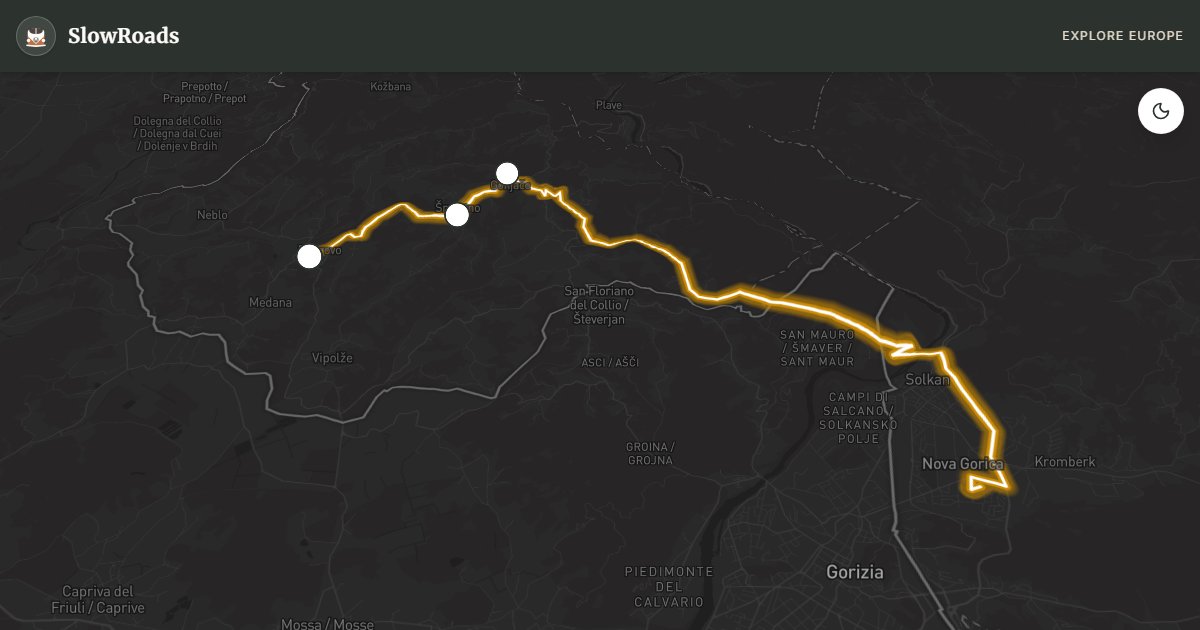
Wander Goriška Brda's wine hills from Nova Gorica to Dobrovo — about 18 km of narrow rolling lanes on the Italian Collio border. Šmartno's walled village, Rebula cellars, cherry orchards, and Gonjače tower views toward the Adriatic suit classic campervans that prefer modest grades to alpine passes. Use passing places; park outside Šmartno walls and walk in. Drive at 0.0% after tastings; overnight at AutoKamp or farm stays, not vineyard lay-bys. Spring blossom and autumn harvest beat midsummer heat. Short distances invite a slow half-day or overnight base for walks between cellars.
Detailed Route Guide
Goriška Brda is one of Slovenia's most beautiful and least-known wine regions — a compact landscape of rolling limestone hills along the Italian border where the Collio Goriziano DOC wine region on the Italian side meets the Slovenian Brda designation, and where the distinction between Slovenian and Italian culture becomes delightfully blurred. The region produces some of the finest white wines in the Eastern Alps, particularly Rebula (Ribolla Gialla in Italian) — an ancient grape variety whose yellow-skinned, amber-tinted wines have become internationally celebrated in recent years through the natural wine movement. A drive through Goriška Brda is simultaneously a wine pilgrimage, a landscape tour, and a cultural immersion in a corner of Central Europe where Habsburg, Italian, and Slavic traditions have mixed for centuries.
The hill towns of the Brda are extraordinary in their preservation: Šmartno, the most visited, is a completely intact medieval village enclosed by its original walls and towers, with a Romanesque church and stone houses that have not changed in character for 500 years. The village is tiny — a few dozen houses — but its integrity is almost unnerving in how completely it has avoided modernisation. From the Gonjače viewing tower (a short drive up from the Brda roads), the panorama extends from the Julian Alps to the north, across the Goriška plain to the Adriatic, and west into the Italian Collio — a view of extraordinary breadth and variety on a clear day.
The cherry orchards of the Brda are one of the region's defining seasonal spectacles: in late April and early May, the hillsides turn white with blossom, and the annual Cherry Festival (Češnjin festival) in Dobrovo draws visitors from across Slovenia and Italy. Later in spring, the cherries ripen into an early harvest and roadside stalls sell them by the kilogram. The vineyards, which cover every south-facing slope, produce their harvest in September and October when the Brda takes on a warm amber and gold character that justifies every Tuscany comparison made about the region.
For a classic / low-power campervan, Goriška Brda is entirely manageable territory despite the narrow, winding nature of its roads — the hills are gentle, the gradients modest, and the surfaces generally good. The main challenge is the width of the roads through the hill villages, which can make passing other vehicles tight. The reward is a completely unhurried, sun-drenched landscape that invites the kind of spontaneous stopping — at a family winery, at a roadside cherry stall, at a hilltop viewpoint — that defines slow travel at its best.
Practical tip: Schengen means you can hop into the Italian Collio for lunch and return the same afternoon — still sleep at a Slovenian AutoKamp or booked farm stay. Narrow lanes need patience when meeting harvest tractors in September–October. Drivers should respect Slovenia’s alcohol rules when tasting Rebula; buy bottles for the campsite evening. Gonjače tower is a short stop with Adriatic views on clear days.
Cherry blossom late April–early May and harvest amber in autumn are the visual peaks. Midday summer heat is hard on older engines in stop-start village traffic — drive early or late.
Frequently Asked Questions
Points of Interest
Gonjače Viewing Tower
Nature
Hilltop tower with views from the Julian Alps to the Adriatic and across to the Italian Collio on clear days.
Šmartno Medieval Village
Town
Walled medieval village in Goriška Brda — park outside the walls and walk in; wine bars inside.
Dobrovo Castle
Castle
17th-century Renaissance palace with wine museum and gallery — logical endpoint of the Brda drive.
Route Highlights
Route Information
Navigation
* Supported by HERE Technologies, headquartered in Amsterdam, Europe. Precise routing through all waypoints.
* Waze only navigates to the starting point. Use Google Maps for the full scenic route.
Offline GPS Navigation
Download the GPX route file to navigate offline using your favorite GPS device or app (Garmin, TomTom, OsmAnd, Gaia GPS).
Ask Copilot (AI Travel Guide)
Hello! I am your SlowRoads Copilot. I know the Goriška Brda (The Wine Hills) intimately. Ask me about scenic viewpoints, local history, hidden culinary gems, or the best camper spots along the way!