Great Dolomite Road (Grande Strada delle Dolomiti)
About This Route
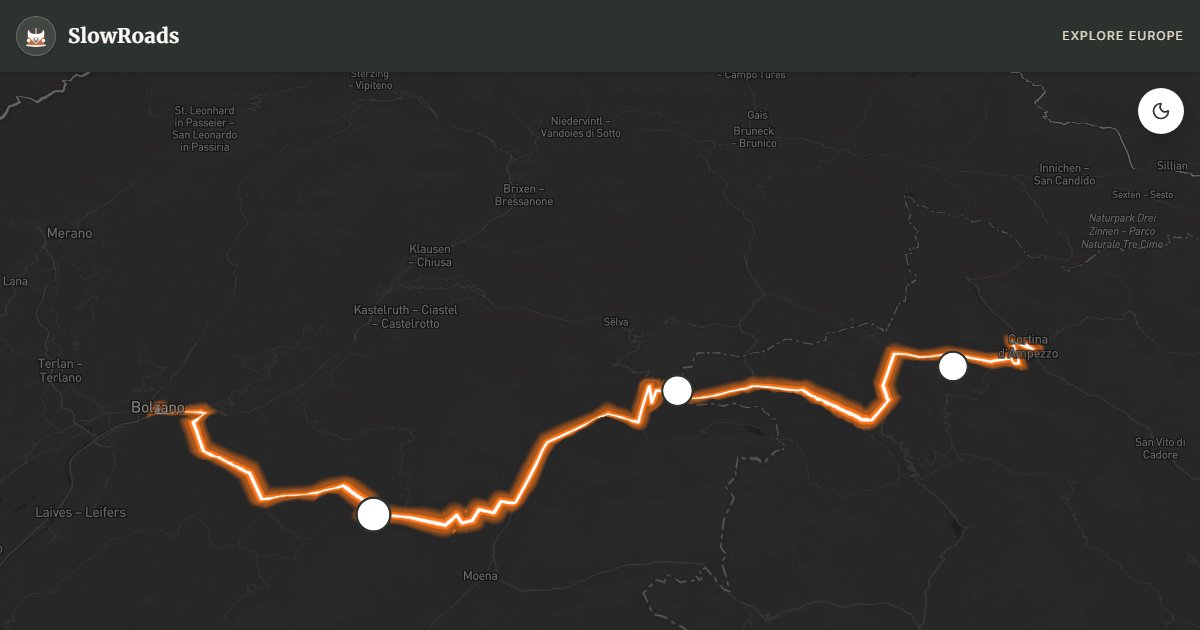
Follow the Grande Strada delle Dolomiti 84 km from Bolzano to Cortina d'Ampezzo via Pordoi (2,239 m) and Falzarego (2,105 m) — UNESCO pale towers, Lake Carezza, and the Cinque Torri war museum plateau. Steep but well-surfaced and mostly two-lane, so classic low-power campervans can manage with patience, cooling stops, and valley fuel stops. Plan two to three days with a night in Canazei or Arabba; do not stack the Sella Ronda the same day. June wildflowers or September light beat midsummer coach queues on the passes.
Detailed Route Guide
The Great Dolomite Road — Grande Strada delle Dolomiti — is one of the historic grand scenic drives of Europe, inaugurated in 1909 and immediately recognised as a route of world-class beauty. Stretching 84 kilometres from Bolzano in the South Tyrol to Cortina d'Ampezzo in the Veneto, it traverses two major passes — the Pordoi at 2,239 metres and the Falzarego at 2,105 metres — while threading through a landscape of pale, vertical rock towers that look less like mountains and more like the ruins of an ancient stone city. The Dolomites, a UNESCO World Heritage Site since 2009, are composed of dolomitic limestone that glows pink and orange at sunset — a phenomenon the Ladins, the indigenous people of these valleys, call the Enrosadira: the mountains on fire.
The route accumulates a remarkable sequence of highlights. Lake Carezza (Karersee), near the start, is a small jade-green lake framed by fir trees and the pinnacles of the Latemar group above — it is one of the most photographed spots in the Dolomites, and rightly so. The Pordoi summit offers a cable car to the Sass Pordoi plateau, a high rocky terrace from which you look across to the entire Sella massif. Near the Falzarego pass, the Cinque Torri — five isolated rock towers on a meadowed plateau — served as First World War fortifications and have been restored as an open-air museum. Cortina d'Ampezzo itself, at the end of the route, is the most elegant mountain resort in Italy, its main street lined with designer boutiques and gelaterie set against the dramatic backdrop of the Tofane towers.
For a classic or low-power campervan, the Great Dolomite Road is a significant undertaking but an entirely achievable one. The passes are genuinely steep, and the Pordoi in particular demands patience, low gears, and careful temperature management. The saving grace is the road's width and quality: it is well-surfaced, generally double-laned, and the hairpins are wide enough for larger vehicles to navigate without difficulty. Plan two to three days for the full route, and build in at least one overnight stop in the Dolomites themselves — the experience of waking in these valleys at dawn, when the first light touches the rock faces, is something that cannot be rushed.
The ideal seasons are June to early July, when the high meadows are carpeted with flowers and the snowfields on the upper peaks have shrunk to their minimum, and September to early October, when the autumn light makes the pale rock seem almost luminous. Midsummer brings heavy traffic through the main passes, and parking at viewpoints can be testing. Whatever season you choose, carry enough fuel to get between the valley towns: petrol stations on the passes themselves are rare.
Practical pacing turns this UNESCO drive into a pleasure rather than a grind. Overnight in Canazei or Arabba so you can cross Pordoi early, before coach traffic fills the summit car parks. Carry enough fuel for the valley-to-valley gaps; pass stations are scarce. For classic and low-power campervans, treat each pass as its own climb: low gears, temperature checks, and a full stop at viewpoints to let the engine breathe. If afternoon thunderstorms build over the Sella, descend to the valley rather than lingering on exposed summits. Pair this route with the shorter Sella Ronda only on a separate day — stacking both in one outing exhausts brakes and patience.
Frequently Asked Questions
Points of Interest
Karersee (Lake Carezza)
Nature
Pordoi Summit
Nature
Cinque Torri
Nature
Route Highlights
Route Information
Navigation
* Supported by HERE Technologies, headquartered in Amsterdam, Europe. Precise routing through all waypoints.
* Waze only navigates to the starting point. Use Google Maps for the full scenic route.
Offline GPS Navigation
Download the GPX route file to navigate offline using your favorite GPS device or app (Garmin, TomTom, OsmAnd, Gaia GPS).
Ask Copilot (AI Travel Guide)
Hello! I am your SlowRoads Copilot. I know the Great Dolomite Road (Grande Strada delle Dolomiti) intimately. Ask me about scenic viewpoints, local history, hidden culinary gems, or the best camper spots along the way!