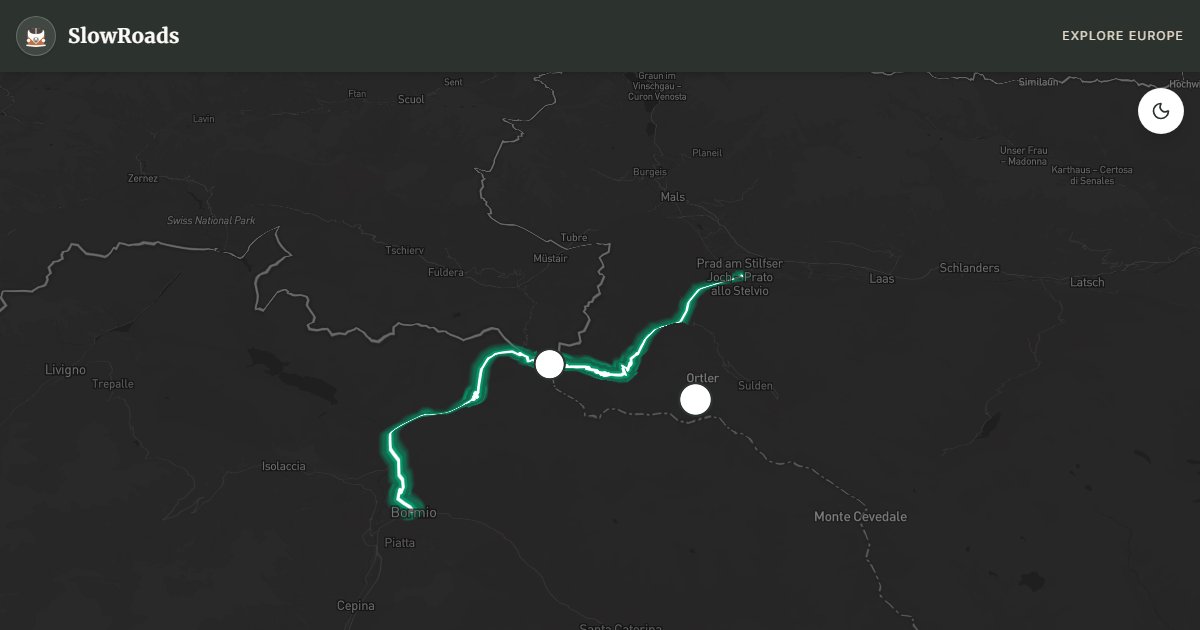
About This Route
Drive Italy's highest paved pass (2,757 m) from Prato allo Stelvio to Bormio — 48 numbered hairpins on the northern ramp, Ortler glacier views, and Stelvio National Park wilderness. This is the hardest alpine day in the guide for classic and low-power campervans: first gear, cooling stops, and engine braking on the descent. Fill fuel in the valleys, start early, and treat July–August motorcycle crowds as optional. Best in early June beside lingering snowbanks or in September's clearer air; snow can close the pass without warning even in summer.
Detailed Route Guide
The Stelvio Pass is the highest paved mountain pass in Italy and the second highest in the entire Alps, reaching 2,757 metres above sea level. It has been declared one of the greatest driving roads in the world, and the statistics alone suggest why: the northern ramp alone contains 48 numbered hairpin bends, stacked so tightly that from above they resemble a coiled spring. The road was built between 1820 and 1825 under Austrian rule as a military and trade route connecting Bormio in Lombardy with the South Tyrol. It remains one of the most astonishing feats of pre-industrial road engineering anywhere in Europe, and driving it feels like entering a different century as much as a different altitude.
The views from the summit are genuinely incomparable. You look south towards the Ortler massif, the highest peak in the Eastern Alps outside the Bernina Range, its glacier-capped summit rising to 3,905 metres. To the north, the Umbrailpass road descends into Switzerland and the Val Mustair. The summit area itself is a small cluster of hotels, restaurants, and souvenir shops that somehow both undermine and confirm the drama of the location. Ignore the commercialism and walk fifty metres from the road in any direction: the silence and the scale of the surrounding peaks quickly reassert themselves. The Stelvio National Park, which surrounds the pass, is one of Italy's largest and most wild protected areas.
For a classic or low-power campervan, the Stelvio Pass is the most demanding route in this entire collection, and you should approach it with full mechanical honesty. The 48 hairpins of the northern ramp will require extended periods in first gear, and your engine temperature gauge will climb steadily. This is not a route to attempt if your cooling system is marginal or your brakes are overdue for attention. That said, many classic and low-power campervans have made this climb successfully — the key is patience. Take it slowly, stop at every hairpin viewpoint to let the engine breathe, use the heater to draw heat away from the engine on the steepest sections, and never switch off the engine when very hot. The descent to Bormio is equally demanding on the brakes. Plan to spend most of the day on this crossing.
The Stelvio is typically open from late May to early November, though snow can close it at any point and sometimes falls even in July. The very best time is early June when the snowbanks beside the road can still be several metres high, or September when the traffic drops and the clarity of the autumn air is extraordinary. July and August see the pass at its busiest, with motorcyclists, cyclists, and sports car enthusiasts all competing for the narrow carriageway. Whatever time of year you visit, start as early as possible: the upper sections are finest in the calm before the crowds arrive.
Fuel and logistics matter as much as courage. Fill up in Prato allo Stelvio or Bormio before you climb — summit services exist but queues and prices punish late arrivals. Carry spare coolant and check tyre pressures for altitude. If your classic or low-power campervan overheats, pull into a numbered hairpin lay-by, idle with the heater on full, and wait until the gauge drops before continuing; never shut down a boiling engine. On the Bormio descent, use engine braking in low gears and pause to cool the discs. Combine the day with the Umbrail Pass into Switzerland only if weather and energy allow — one high crossing is enough for most older vans.
Frequently Asked Questions
Points of Interest
Stelvio Summit
Nature
Ortler Views
Nature
Route Highlights
Route Information
Navigation
* Supported by HERE Technologies, headquartered in Amsterdam, Europe. Precise routing through all waypoints.
* Waze only navigates to the starting point. Use Google Maps for the full scenic route.
Offline GPS Navigation
Download the GPX route file to navigate offline using your favorite GPS device or app (Garmin, TomTom, OsmAnd, Gaia GPS).