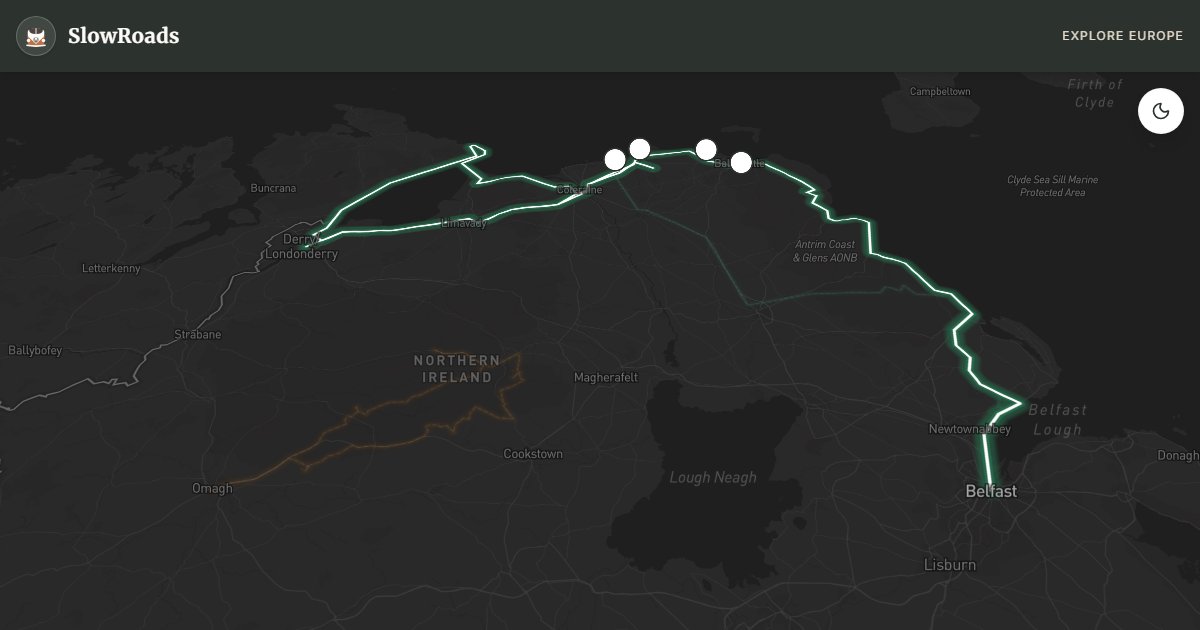
Causeway Coastal Route (Full)
About This Route
Full Antrim coast of about 328 km: nine Glens, Torr Head single-track, Carrick-a-Rede rope bridge, Giant's Causeway, and Mussenden Temple toward Derry. Allow three to four days for classic and low-power campervans; book Carrick-a-Rede tickets and use campsites only. Torr Head needs passing places and patience with oncoming traffic. Early starts beat coach convoys on the A2. The fuller sibling of the Causeway route — more single-track drama, more harbour nights, and more Atlantic weather windows to watch. Allow extra time for photo pullouts, fuel stops, and cooling breaks in older vans.
Detailed Route Guide
The full Causeway Coastal Route is Northern Ireland's definitive slow-travel road — a 328-kilometre journey from Belfast to Derry~Londonderry that takes in every dramatic inch of the Antrim coast rather than rushing the highlights. While the shorter Belfast-to-Causeway section is well known, the complete route rewards those who allow three or four days to explore the nine Glens of Antrim, cross Torr Head (the closest point on the island of Ireland to Scotland, where on clear days the Mull of Kintyre appears close enough to touch), walk the Carrick-a-Rede rope bridge, and linger at Dunluce Castle before the road turns west toward the walled city of Derry. For a classic campervan crew, this is van-friendly territory: the A2 is well surfaced, gradients are modest, and wild camping is not legal as in Scotland — use harbours, caravan parks, and campgrounds for overnight stays.
Leaving Belfast via the M2 and A2, the route skirts Belfast Lough before Carrickfergus Castle — one of Ireland's best-preserved Norman fortresses — marks the transition to open coast. Larne begins the Antrim coast proper, and from here the road weaves through Glenarm, Carnlough, and Cushendall, each glen cutting back into heather-covered hills with waterfalls and stone walls. Cushendun, a National Trust village of whitewashed cottages, is one of the most photogenic stops on the entire route. The climb to Torr Head on the Torr Road detour is narrow and demands patience in a classic campervan, but the view across the North Channel to Scotland is unforgettable.
The central section from Ballycastle to Bushmills concentrates the route's geological drama. Carrick-a-Rede rope bridge — suspended 30 metres above the churning Atlantic — requires timed tickets in summer but is manageable year-round with advance booking. The Giant's Causeway UNESCO site needs no introduction: 40,000 interlocking basalt columns stepping into the sea, best approached via the cliff-top path from Bushmills rather than the busy visitor centre car park. Dunluce Castle, perched on a sea stack, adds medieval romance. Old Bushmills Distillery (1608) sits between these wonders.
West of the Causeway, the coast softens toward Portstewart and Downhill before the route enters County Derry. Mussenden Temple on the clifftop at Downhill is a neoclassical folly with extraordinary views. The final approach to Derry~Londonderry crosses the Foyle estuary to a walled city whose 17th-century fortifications remain complete — a fitting end to one of Europe's great coastal drives. Allow three days minimum; four if you walk glens, visit Rathlin Island ferry from Ballycastle, or explore the Dark Hedges near Ballymoney as a morning detour.
Book Carrick-a-Rede timed tickets from Easter through September. Torr Head single-track needs patience and passing places in a classic campervan — do not block lay-bys overnight. Add Mussenden Temple and Portstewart Strand on the western run into Derry’s complete walls. Three days minimum; four with Rathlin ferry or Dark Hedges. Campsites at Ballycastle, Bushmills, Portstewart, and Derry periphery — wild camping is not a right. Pair with Mournes or Fermanagh for a full Northern Ireland fortnight.
Treat Torr Head as optional in a long or nervous classic campervan — the detour is single-track with limited passing, spectacular on a calm day, stressful in oncoming coach traffic. Book Carrick-a-Rede timed tickets in season and arrive early at Giant’s Causeway parking. Overnight only at campsites and caravan parks; Northern Ireland has no wild-camping right like Scotland. Left-hand drive, mph, and GBP are the daily logistics. Allow three to four days so Glens villages and Mussenden are not rushed photo stops.
Frequently Asked Questions
Points of Interest
Carrick-a-Rede Rope Bridge
Nature
Dramatic rope bridge to island
Giant's Causeway
Nature
UNESCO basalt columns
Torr Head
Nature
Closest point to Scotland
Dunluce Castle
Castle
Cliff-perched medieval fortress
Route Highlights
Route Information
Navigation
* Supported by HERE Technologies, headquartered in Amsterdam, Europe. Precise routing through all waypoints.
* Waze only navigates to the starting point. Use Google Maps for the full scenic route.
Offline GPS Navigation
Download the GPX route file to navigate offline using your favorite GPS device or app (Garmin, TomTom, OsmAnd, Gaia GPS).
Ask Copilot (AI Travel Guide)
Hello! I am your SlowRoads Copilot. I know the Causeway Coastal Route (Full) intimately. Ask me about scenic viewpoints, local history, hidden culinary gems, or the best camper spots along the way!