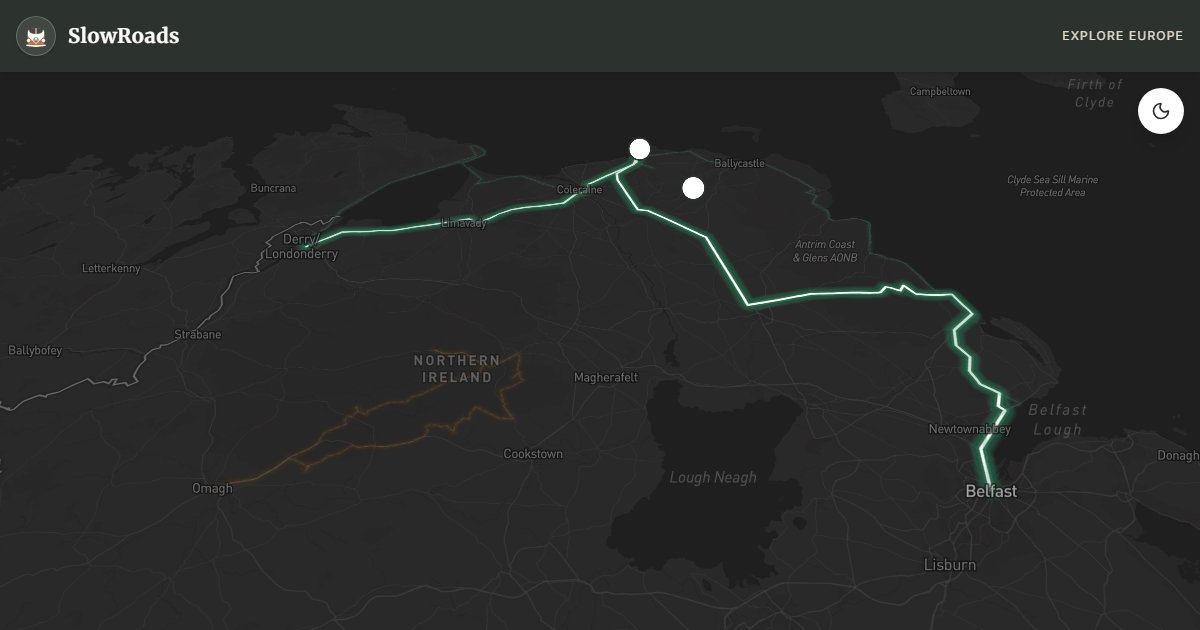
About This Route
Northern Ireland's signature coastal drive of about 182 km from Belfast to Derry~Londonderry — Glens of Antrim, Giant's Causeway UNESCO basalt, and Dunluce Castle on the A2. Left-hand traffic and mph limits; use campsites and harbours only — no wild-camping right. Classic and low-power campervans thrive if you avoid peak coach queues and arrive early at the Causeway. Short daily stages reward cliff light and harbour chowder. Book Carrick-a-Rede if combining with the fuller Antrim coast. Atlantic weather changes fast — layers and patience.
Detailed Route Guide
The Causeway Coastal Route is widely regarded as one of the finest coastal drives in the world — a 182-kilometre journey from Belfast to Derry~Londonderry along the rugged north Antrim and north Derry coasts of Northern Ireland. Ranked alongside the Great Ocean Road in Australia and Route 1 in California by travel publications, it combines dramatic volcanic geology, medieval castles, whiskey distilleries, and some of the most spectacular cliff scenery in Europe. For a slow traveller in a classic or low-power campervan, this is a route that rewards unhurried exploration: there is no stretch of tarmac here that does not offer something worth stopping for, and the coastal light changes so dramatically through the day that the same viewpoint can look entirely different between morning and afternoon.
Belfast itself is an excellent starting point. The city underwent a remarkable cultural and architectural regeneration following the peace process, and the Titanic Quarter — with its award-winning Titanic Belfast museum built on the very slipway where the ship was constructed — is among the finest maritime heritage sites in the world. The Cathedral Quarter is vibrant with bars, restaurants, and live music. The route leaves Belfast via the M2 and A2, skirting the shores of Belfast Lough and the picturesque town of Carrickfergus with its imposing Norman castle — one of the best-preserved medieval castles in Ireland, dating from the late 12th century and still largely intact.
North of Carrickfergus, the route passes through Larne and along the Antrim coast proper, which begins to reveal its character: high basalt cliffs of dark volcanic rock, glens cutting back into the interior, and a sea that shifts between deep blue and storm grey depending on the weather. The nine Glens of Antrim — glacially carved valleys that descend to the coast — each have distinct personalities and the roads through them are beautiful. Cushendall, Cushendun (a National Trust village of whitewashed cottages), and Ballycastle are the main settlements. From Ballycastle, the viewpoint across to Rathlin Island (a few kilometres offshore) is unforgettable, and a ferry from the town makes island day trips possible.
The highlight of the entire route is the Giant's Causeway — a UNESCO World Heritage Site and the single most extraordinary natural feature in Ireland. Approximately 40,000 interlocking basalt columns formed by ancient volcanic activity step from the clifftops into the sea in a pattern so regular and geometric that legends of giant stone builders were inevitable. The Causeway is managed by the National Trust and can be approached via the visitor centre (paid parking) or from the cliff-top path from Bushmills (free). A classic campervan parked at Bushmills and the walk along the cliff-top path to the Causeway offers the best arrival — the reveal of the columns from above is magnificent. Nearby Dunluce Castle, a medieval fortress dramatically perched on a sea stack connected to the mainland by a narrow bridge, is another must-stop.
Allow two to three days so Belfast’s Titanic Quarter, the Glens villages, and the Causeway itself each get unhurried time. Drive on the left; fill fuel before quieter stretches west of Bushmills. Overnight at Ballycastle or Bushmills caravan parks — beach and lay-by overnighting draws fines. Classic and low-power campervans find few grades on the A2; the challenge is summer parking and coach traffic. Arrive before 9 at the Causeway, and treat Dark Hedges as a short morning walk from nearby parking now that the beech road is vehicle-closed.
Frequently Asked Questions
Points of Interest
Giant's Causeway
Nature
UNESCO World Heritage basalt columns — arrive via Bushmills cliff path to avoid peak visitor-centre parking.
Dark Hedges
Nature
Eighteenth-century beech tunnel near Armoy — road closed to vehicles; short walk from nearby parking.
Dunluce Castle
Castle
Medieval fortress on a sea stack west of the Causeway — cliff-edge ruins with Atlantic views.
Carrickfergus Castle
Castle
Well-preserved Norman castle on Belfast Lough — early stop on the A2 coastal run north.
Route Highlights
Route Information
Navigation
* Supported by HERE Technologies, headquartered in Amsterdam, Europe. Precise routing through all waypoints.
* Waze only navigates to the starting point. Use Google Maps for the full scenic route.
Offline GPS Navigation
Download the GPX route file to navigate offline using your favorite GPS device or app (Garmin, TomTom, OsmAnd, Gaia GPS).
Ask Copilot (AI Travel Guide)
Hello! I am your SlowRoads Copilot. I know the Causeway Coastal Route intimately. Ask me about scenic viewpoints, local history, hidden culinary gems, or the best camper spots along the way!