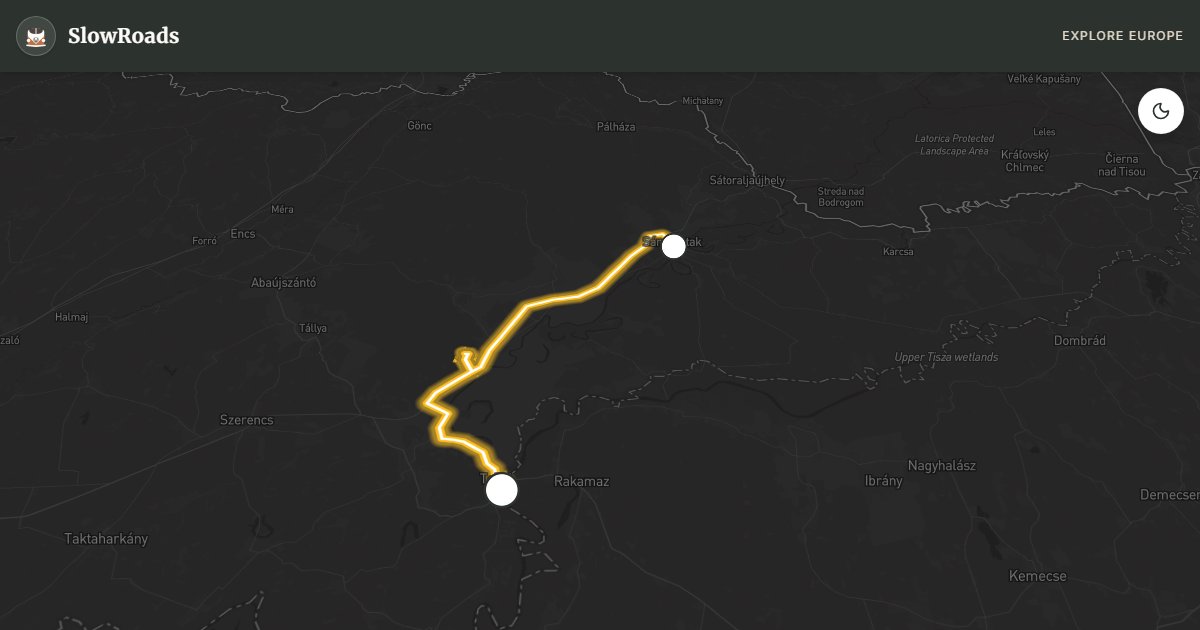
About This Route
Roll the UNESCO Tokaj wine hills from Tokaj to Sárospatak via Mád — about 40 km of gentle foothill lanes for older and low-power campervans. Foggy Bodrog–Tisza confluence country produces Furmint and Tokaji Aszú; visit the Rákóczi Cellar under Tokaj's square and end at Sárospatak Castle on the Bodrog. Grades stay modest compared with Bükk — patience and pull-ins matter more than horsepower. Drive at 0.0% alcohol; buy bottles for the campsite. Official campsites and guesthouse parking only. October harvest light is superb; spring blossom is quieter. Carry forint cash for small cellars and fill fuel before leaving town services.
Detailed Route Guide
The Tokaj wine region occupies a special corner of northeast Hungary where the Bodrog and Tisza rivers converge at the foot of the Zemplén Hills — a confluence of waterways that creates the unique foggy microclimate responsible for the noble rot (Botrytis cinerea) that makes Tokaji Aszú one of the world's greatest dessert wines. In 2002, the entire region was inscribed as a UNESCO World Heritage Site — not just for its wine, but for the complete cultural landscape of vine terraces, wine cellars, and historic market towns that have evolved over 400 years of winemaking. This 40-kilometre route from Tokaj to Sárospatak explores the heartland of this ancient wine country through rolling volcanic foothills and medieval villages, and it is gentle enough for any vintage van to navigate without drama.
The town of Tokaj itself stands at the confluence of the two rivers and is the spiritual capital of the wine region. Its main street is lined with wine houses offering Tokaji in all its forms: from the crisp, dry Furmint base wine to the legendary Aszú in its ornate 0.5-litre bottles measured in "puttonyos" (the number of baskets of shrivelled botrytised grapes added, from 3 to 6). The Rákóczi Cellar beneath the main square is a vast, ancient underground system open for tours and tastings. From Tokaj, the route heads north through the village of Mád — considered by connoisseurs to be the finest wine village in the entire region, with a concentration of top producers in a remarkably small area. The Church of Mád, rebuilt in Baroque style over a medieval base, anchors the village square. The finale is Sárospatak, a cultured small city on the Bodrog river with a majestic Renaissance castle complex that was the seat of the Rákóczi family — the princes who led Hungary's great anti-Habsburg uprising of 1703–11.
For older and low-power campervan drivers, this route requires almost no special preparation. The roads between the wine towns are gently rolling — the hills are present but the gradients rarely exceed 5–6% for any sustained distance. The main concern is finding parking in Mád, which has very narrow streets; park at the village entrance and walk to the wine houses. Road surfaces throughout are good, and traffic is light outside of summer weekends. The region's wine cellars are cool year-round (around 12°C), making them a welcome refuge on a hot day. Fuel is available in Tokaj and Sárospatak; smaller villages have no stations.
Timing a visit around the harvest (late September to mid-October) is the most rewarding experience in the Tokaj region. During this period, the vineyards are active, the air smells of fermenting must, and many cellars offer harvest-season tastings at reduced prices. Summer brings the most open wineries and longest hours. Spring, particularly May when the vines flower, is quietly beautiful. Winter is atmospheric — the mist over the river confluence is particularly evocative — but many smaller producers close until Easter. Whatever the season, Tokaj deserves at minimum two nights to explore its cellars properly without rushing.
Practical tip: e-matrica is irrelevant on these secondary wine roads. Park at Mád’s entrance and walk — streets are too narrow for comfortable van turning. Respect 0.0% when tasting; many cellars sell bottles for later. Fuel in Tokaj or Sárospatak. Overnight at campsites or booked stays, not vineyard lay-bys.
Harvest late September–mid-October is the most atmospheric window; spring vine flower is quieter. Two nights beat a rushed day if you want both Aszú cellars and Sárospatak Castle without hurry.
Frequently Asked Questions
Points of Interest
Rákóczi Cellar
Monument
Vast historic cellar under Tokaj's main square — tours and tastings of Furmint and Tokaji Aszú.
Sárospatak Castle
Castle
Renaissance–Baroque Rákóczi castle complex on the Bodrog — museum and red tower in the town centre.
Route Highlights
Route Information
Navigation
* Supported by HERE Technologies, headquartered in Amsterdam, Europe. Precise routing through all waypoints.
* Waze only navigates to the starting point. Use Google Maps for the full scenic route.
Offline GPS Navigation
Download the GPX route file to navigate offline using your favorite GPS device or app (Garmin, TomTom, OsmAnd, Gaia GPS).
Ask Copilot (AI Travel Guide)
Hello! I am your SlowRoads Copilot. I know the Tokaj Wine Region intimately. Ask me about scenic viewpoints, local history, hidden culinary gems, or the best camper spots along the way!