About This Route
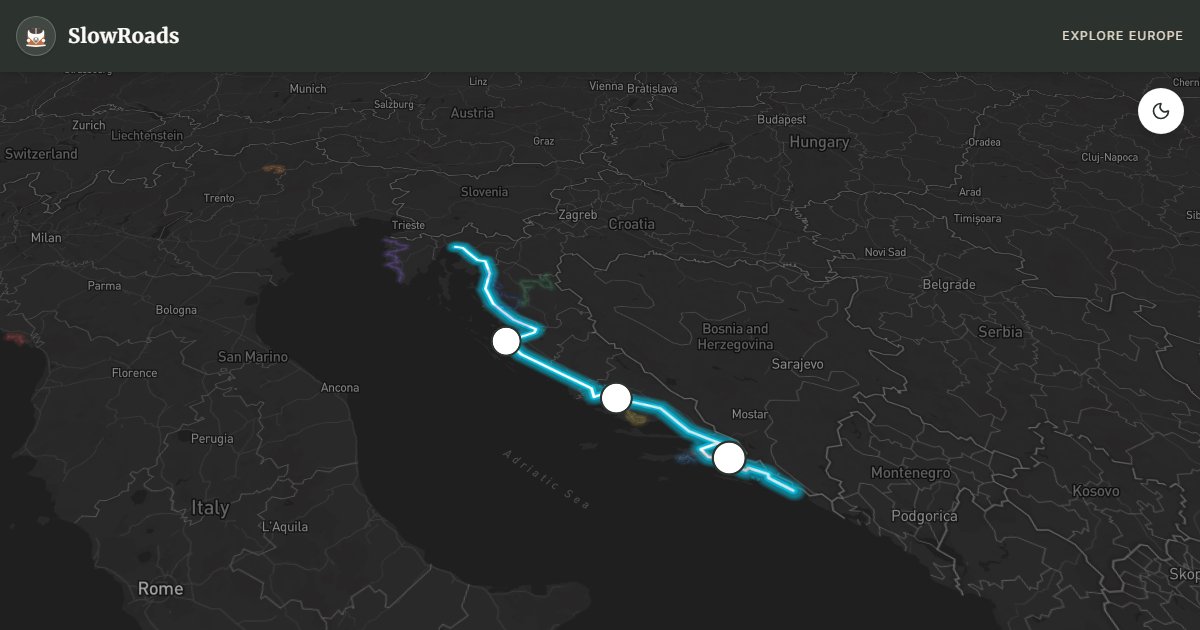
The Jadranska Magistrala (D8) is one of the world's great coastal roads — snaking from Rijeka toward Dubrovnik with turquoise Adriatic on one side and karst mountains on the other. Hundreds of curves, hidden coves, and historic stone towns reward classic and low-power campervans that cruise early and accept short coastal gradients. Mostly flat with occasional climbs; summer coaches and heat demand patience. Autokamp only — wild camping (slobodno kampiranje) is banned. Shoulder seasons beat August gridlock into Dubrovnik; fill fuel before long cliff stretches.
Detailed Route Guide
The Jadranska Magistrala — Route D8 — is one of the great drives of the world. Stretching 562 kilometres from the port city of Rijeka south to the walled city of Dubrovnik, it follows almost every inch of Croatia's Dalmatian coastline. To your left: crystal-clear Adriatic water in impossible shades of turquoise, dotted with more than a thousand islands. To your right: the raw white limestone of the Dinaric Alps dropping sheer into the sea. For centuries traders, crusaders, and emperors moved along this shore; today you cover it in a vintage van with the windows down.
The route builds like a symphony. From Rijeka, the road passes through Senj — a walled medieval town with a fierce pirate history — before opening out along empty karst cliffs. Zadar offers the world-famous Sea Organ, a marble staircase that converts wave energy into hauntingly beautiful music, and the Sun Salutation, a solar-powered light installation by architect Nikola Bašić. Šibenik marks the gateway to Dalmatia proper; its UNESCO-listed Cathedral of St James was built entirely from local stone. Trogir — another UNESCO Old Town set on a tiny island — is connected to the mainland by just two bridges and feels entirely outside of time. Then Split and the jaw-dropping Diocletian's Palace: a Roman emperor's retirement villa turned living city where 3,000 people still live inside third-century walls. South of Split the Makarska Riviera offers the best beaches on the entire coast, shaded by the vertical cliffs of the Biokovo massif. Finally, the 2022 Pelješac Bridge — at 2.4 kilometres one of the longest bridge structures in this part of Europe — carries you over the sea to the Pelješac Peninsula before the last stretch to Dubrovnik.
For a classic or low-power campervan, the D8 is remarkably friendly. The road is almost entirely flat or gently rolling — only a handful of short coastal climbs demand a gear change. There are petrol stations in every major town, campsites with sea views every few kilometres in summer, and ferry connections to the islands if you want to extend the adventure. The one serious caveat is traffic in July and August: the Adriatic Highway becomes a slow-moving procession of tourist vehicles, and Dubrovnik's access roads grind to a halt daily. Plan your driving for early mornings or arrive in late June or September when the road is quieter and the sea is still warm.
The ideal pace for the full 562 kilometres is five to seven days — long enough to stop in every town that catches your eye, swim in hidden coves accessible only by foot path, and eat grilled fish at harbour-side konobas as the sun drops into the Adriatic. This is slow travel in its purest form: a road that rewards patience, curiosity, and an unhurried engine.
Budget five to seven days for the full Rijeka–Dubrovnik run if you want Zadar's Sea Organ, Šibenik and Trogir stone towns, Split's Diocletian's Palace, Makarska swims, Ston walls, and Dubrovnik without treating any stop as a drive-by. Classic and low-power campervans thrive on early starts and shoulder seasons; Autoceste tolls are optional — the D8 is the scenic, toll-free spine.
Frequently Asked Questions
Points of Interest
Zadar Sea Organ
Monument
Diocletian's Palace (Split)
Castle
Pelješac Bridge
Monument
Route Highlights
Route Information
Navigation
⚠️ Google Maps has a 10-stop limit. Route is simplified and might bypass some scenic sections.
* Supported by HERE Technologies, headquartered in Amsterdam, Europe. Precise routing through all waypoints.
* Waze only navigates to the starting point. Use Google Maps for the full scenic route.
Offline GPS Navigation
Download the GPX route file to navigate offline using your favorite GPS device or app (Garmin, TomTom, OsmAnd, Gaia GPS).