About This Route
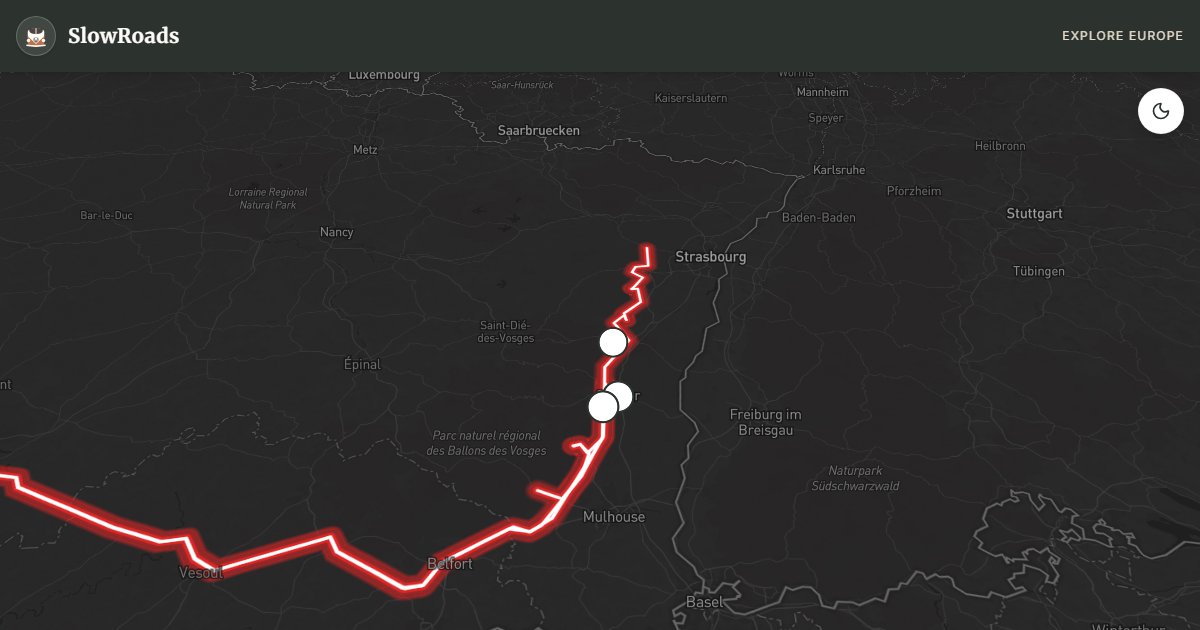
Drive France's Route des Vins d'Alsace from Marlenheim to Thann: 737 km of Vosges foothills, half-timbered wine villages and Grand Cru slopes. Gentle grades suit classic campervans; park outside Eguisheim, Riquewihr and Colmar's Petite Venise and walk in. Riesling, Gewurztraminer and autumn harvest festivals reward unhurried tasting stops. Allow 3–5 days for Colmar's Musée Unterlinden, vineyard paths and quieter southern villages toward Guebwiller. September–October bring Vendanges energy; December Christmas markets are among Europe's finest — book aires early. A slow, flat-to-rolling wine country drive built for older low-power vans.
Detailed Route Guide
The Alsace Wine Route (Route des Vins d'Alsace) is one of France's best-known wine routes, officially inaugurated in 1953 (France's first dedicated wine route was the Route des Grands Crus in Burgundy, 1937), and runs 737 kilometres along the eastern foothills of the Vosges mountains from Marlenheim north of Strasbourg to Thann in the south. The route passes through nearly 70 wine-producing villages in a landscape of extraordinary medieval charm: half-timbered houses in every shade of pastel, flower-decked windows, ruined hilltop castles rising above the vines, and a cultural identity that is emphatically neither fully French nor fully German but specifically Alsatian — the product of centuries of border ambiguity and a people who made the best of it.
The Alsatian landscape is immediately recognizable. The half-timbered construction style (colombage) reaches its apex here, with buildings in Eguisheim, Riquewihr, and Kaysersberg whose carved wooden beams, painted plaster panels, and overhanging upper storeys look exactly as they did five centuries ago. Many of these villages have never been significantly damaged in war — they were simply too small and remote to be worth destroying — and the result is an authenticity that larger cities cannot replicate. The geraniums cascading from every window box are not a tourist board invention; they reflect a genuine Alsatian pride of appearance that expresses itself in one of Europe's most photogenic built environments.
Colmar, the route's largest and most important town, is worth at least a day on its own. The 'Petite Venise' quarter — half-timbered buildings reflected in the canal of the Lauch river — is one of the most photographed scenes in France. The Musée Unterlinden holds Grünewald's Isenheim Altarpiece, one of the most powerful works of art in Europe and not to be missed. The town's covered market, the Hôtel de Ville, and the Dominican church with its Madonna of the Rose Arbour add layers of medieval richness that reward slow exploration.
The wine itself deserves more than a passing mention. Alsace is best known for single-varietal whites — mostly dry, though late-harvest Vendanges Tardives and Sélection de Grains Nobles styles also appear — plus Pinot Noir as the region's red (and occasional rosé), in a style shaped by cold Vosges winters and warm, dry summers. The principal varieties are Riesling (the noblest), Gewurztraminer (aromatic, spicy, difficult to match with food), Pinot Gris (rich and full-bodied), Pinot Blanc (the everyday wine), and Sylvaner (crisp and underrated). The route's northern section near Molsheim and Rosheim produces elegant Pinot Noirs; the southern section around Guebwiller, protected from western rain by the highest Vosges, produces the most concentrated Rieslings and Gewurztraminers.
For van drivers, the Alsace Wine Route is perfectly suited to a slow motor. The road through the foothills is gentle, occasionally climbing to the vineyard terraces but never steeply. The main road (the D35) is straightforward, well-signposted, and carries enough traffic to keep fuel and food options frequent. The main practical challenge is that the most beautiful villages (Eguisheim, Riquewihr, Kaysersberg) have centres closed to motor traffic — park at the edge of town and walk in. Most villages have dedicated motorhome parking areas. The route also connects to the Alsatian Grand Cru vineyards, whose slopes can be walked via a network of marked vineyard paths.
Frequently Asked Questions
Points of Interest
Haut-Kœnigsbourg Castle
Castle
Petite Venise (Colmar)
Town
Eguisheim Central Square
Town
Route Highlights
Route Information
Navigation
⚠️ Google Maps has a 10-stop limit. Route is simplified and might bypass some scenic sections.
* Supported by HERE Technologies, headquartered in Amsterdam, Europe. Precise routing through all waypoints.
* Waze only navigates to the starting point. Use Google Maps for the full scenic route.
Offline GPS Navigation
Download the GPX route file to navigate offline using your favorite GPS device or app (Garmin, TomTom, OsmAnd, Gaia GPS).