About This Route
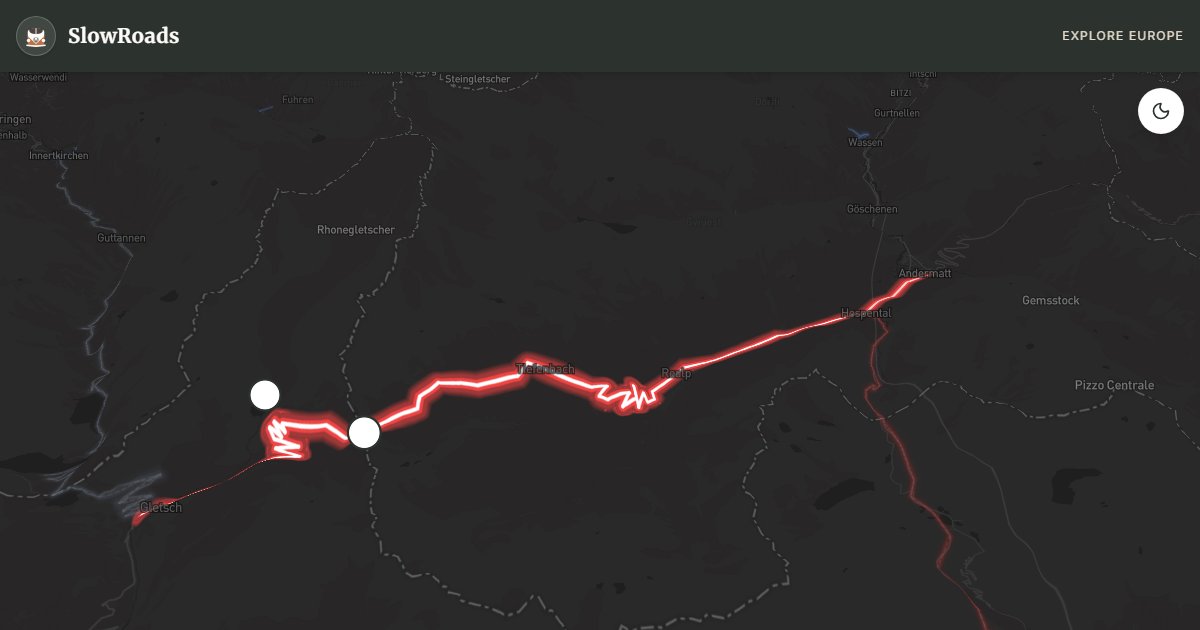
Goldfinger's alpine chase road: Andermatt to Gletsch over Furka (2,429 m) past Hotel Belvédère and the Rhone Glacier ice cave approach. Sustained ~10% grades and hairpins test classic and low-power campervans — cool early, engine-brake down, and use signed lay-bys as rests. No pass toll (Kantonsstrasse); Autobahn still needs the CHF 40 vignette (14 months). Open roughly June–October; pair with Susten and Grimsel for the Three-Pass day. Fuel in Andermatt or Oberwald before the high miles; wild camping is banned nationwide.
Detailed Route Guide
The Furka Pass is Switzerland's most cinematic mountain road — a fact established forever in 1964 when the opening car chase of James Bond's Goldfinger was filmed along its hairpins. Bond's silver Aston Martin DB5 pursues a white Triumph through the switchbacks as the Rhone Glacier glitters in the background, and the sequence established the Furka as an icon of high Alpine motoring. That reputation has endured for sixty years. The 28-kilometre route from Andermatt to Gletsch climbs to 2,429 metres at the summit — making it the fourth-highest paved mountain pass in Switzerland — and connects the Uri and Valais cantons across one of the most dramatic passes in the Alps.
The road's signature landmark is the Hotel Belvédère, perched directly beside the Rhone Glacier at 2,274 metres. The hotel, which dates from the late 19th century and once received guests arriving by horse-drawn carriage, has been closed since 2015 but remains one of the most distinctive buildings in the Alps — a lonely, white structure against an immense field of rock and ice. The Rhone Glacier itself, the source of the Rhône and one of the great Swiss glaciers, has retreated dramatically in recent decades and its current extent is marked against photographs from decades past that show how much ice has been lost. A short walk leads to the glacier's snout, where in summer the ice is wrapped in white fleece to slow the melting. The view from the Furka summit in clear conditions extends across a wilderness of high Alpine peaks that is genuinely humbling.
For a classic or low-power campervan, the Furka is a serious mountain pass. The road to the summit from Andermatt involves a sustained climb with numerous hairpins and gradients reaching 10 percent. Your engine will work hard and your temperature gauge needs watching. The road is well-maintained and wide enough for comfortable single-lane travel, but meeting a bus or truck in a hairpin requires careful negotiation. Use engine braking on the descent and allow the brakes to cool at the lay-bys. The pass is typically open from June to October — check the current status at the Swiss alpine pass information site before departure. Combining the Furka with the adjacent Susten and Grimsel passes (the famous Swiss Three-Pass day) is the classic local road trip and one of the great Alpine drives in the world.
The best time to drive the Furka is June to September. The June opening, when snow still lies on the roadside and the pass may have fresh snowfall, is particularly dramatic — you drive through a white landscape with only the tarmac cleared. August brings the peak of tourists and motorcyclists. September is quieter, cooler, and the light is exceptional for photography. The steam railway Dampfbahn Furka-Bergstrecke runs alongside part of the pass road in summer — a narrow-gauge line that was partially used in the filming of Goldfinger and is one of the highest steam railways in Europe.
Frequently Asked Questions
Points of Interest
Hotel Belvédère
Monument
Rhone Glacier
Nature
Route Highlights
Route Information
Navigation
* Supported by HERE Technologies, headquartered in Amsterdam, Europe. Precise routing through all waypoints.
* Waze only navigates to the starting point. Use Google Maps for the full scenic route.
Offline GPS Navigation
Download the GPX route file to navigate offline using your favorite GPS device or app (Garmin, TomTom, OsmAnd, Gaia GPS).
Ask Copilot (AI Travel Guide)
Hello! I am your SlowRoads Copilot. I know the Furka Pass intimately. Ask me about scenic viewpoints, local history, hidden culinary gems, or the best camper spots along the way!