About This Route
Granite 'staircase' pass through Bernese Oberland dams and deep-blue reservoirs — raw hydro landscape between Innertkirchen and Gletsch for patient drivers. Classic and low-power campervans face sustained grades; cool in lay-bys and descend on engine braking rather than riding the pedal. No pass toll; part of the Three-Pass loop with Furka and Susten. Open roughly June–October depending on snow. Fuel in Innertkirchen or Oberwald; overnight in valley campsites. September clarity and fewer bikes beat midsummer queues at the dam viewpoints.
Detailed Route Guide
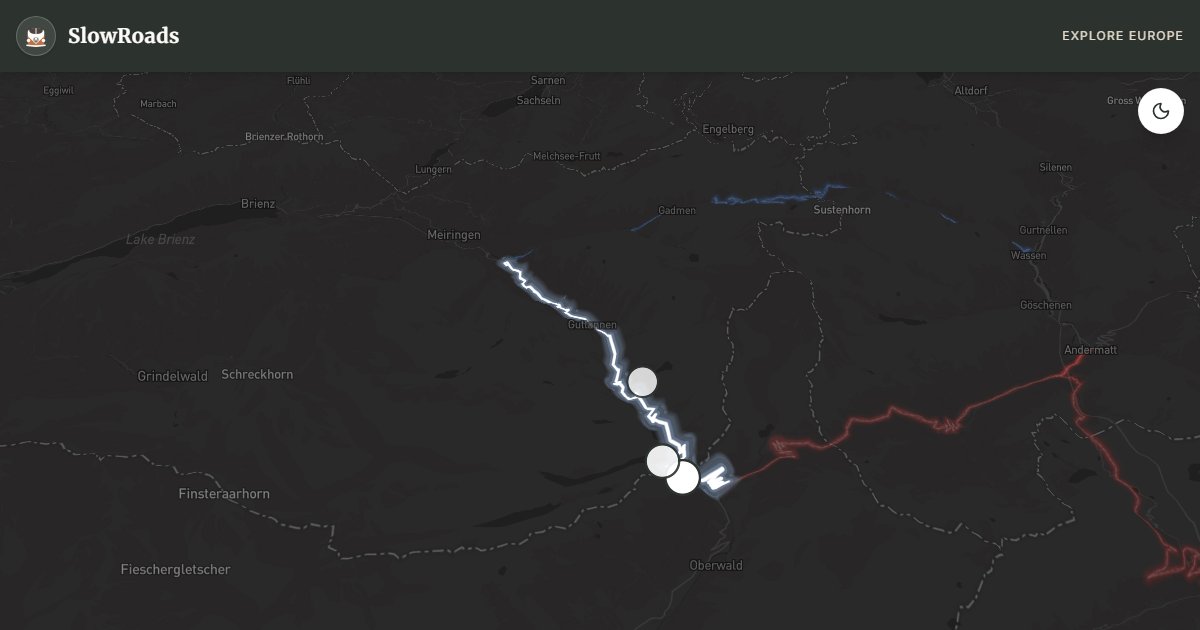
The Grimsel Pass is Switzerland's most dramatically industrial Alpine road — a landscape where high-altitude hydroelectric engineering and ancient Alpine grandeur have collided to create something entirely unique. The 31-kilometre route from Gletsch (where it meets the Furka Pass road) to Innertkirchen in the Bernese Oberland crosses a 2,165-metre summit and descends through a staircase of massive reservoir lakes whose sheer concrete dam walls rise from the granite like monuments to 20th-century engineering ambition. The Grimselsee, Räterichsbodensee, and Gelmersee form a sequence of electric-blue artificial lakes that have been compared to a science-fiction landscape — and the comparison is apt.
The centrepiece of the summit area is the Totensee ("Lake of the Dead"), a small natural lake that has been supplemented by a dam and sits directly at the pass summit surrounded by bare granite in every direction. The Grimsel Hospiz, originally founded in the 13th century as a shelter for travellers crossing the pass, still operates as a hotel and restaurant at the lake's edge — one of the most dramatically situated historic buildings in the Alps. The building itself has been rebuilt multiple times over the centuries, and the current structure combines stone walls with modern design in a way that suits the austerity of the landscape. The descent from the summit towards Innertkirchen is the most spectacular section: the road zig-zags down the north face in a series of hairpins through a bare granite landscape, past the Grimselsee dam wall, and through the Haslital valley where the gradient eases and forests return.
For a classic or low-power campervan, the Grimsel presents the same fundamental challenge as the other major Swiss passes — a sustained climb requiring low gears, close attention to engine temperature, and engine braking on the descent. The road surface is excellent but the bends can be tight and the exposed sections subject to strong winds. The Grimsel is typically the most popular of the Three-Pass combination and can have heavy motorcycle traffic on summer weekends. The pass is open from May to November, with the exact dates depending on snowfall. The Handeck waterfall, accessible via a short walk from the road on the northern descent, is one of the most powerful falls in the Alps — the Aare river plunges 46 metres in multiple stages over a cliff of pink granite.
The Grimsel region has particular historical significance as the site of several battles in the Napoleonic Wars (1799) and as the location of intensive Swiss hydroelectric development that began in the 1920s. The Swiss electric grid receives a substantial proportion of its power from the Grimsel facilities, and the engineering tour-de-force of the dam walls, tunnels, and underground power stations is an attraction in itself. Kraftwerke Oberhasli, the operator, offers tours of the underground facilities in summer. The glacier erosion scars visible on the surrounding granite — smooth, curved grooves left by ice during the last glacial maximum — give the landscape an ancient, lunar quality that is unique among European Alpine roads.
Frequently Asked Questions
Points of Interest
Totensee
Nature
Grimsel Hospiz
Monument
Gelmersee (nearby)
Nature
Route Highlights
Route Information
Navigation
* Supported by HERE Technologies, headquartered in Amsterdam, Europe. Precise routing through all waypoints.
* Waze only navigates to the starting point. Use Google Maps for the full scenic route.
Offline GPS Navigation
Download the GPX route file to navigate offline using your favorite GPS device or app (Garmin, TomTom, OsmAnd, Gaia GPS).
Ask Copilot (AI Travel Guide)
Hello! I am your SlowRoads Copilot. I know the Grimsel Pass intimately. Ask me about scenic viewpoints, local history, hidden culinary gems, or the best camper spots along the way!