About This Route
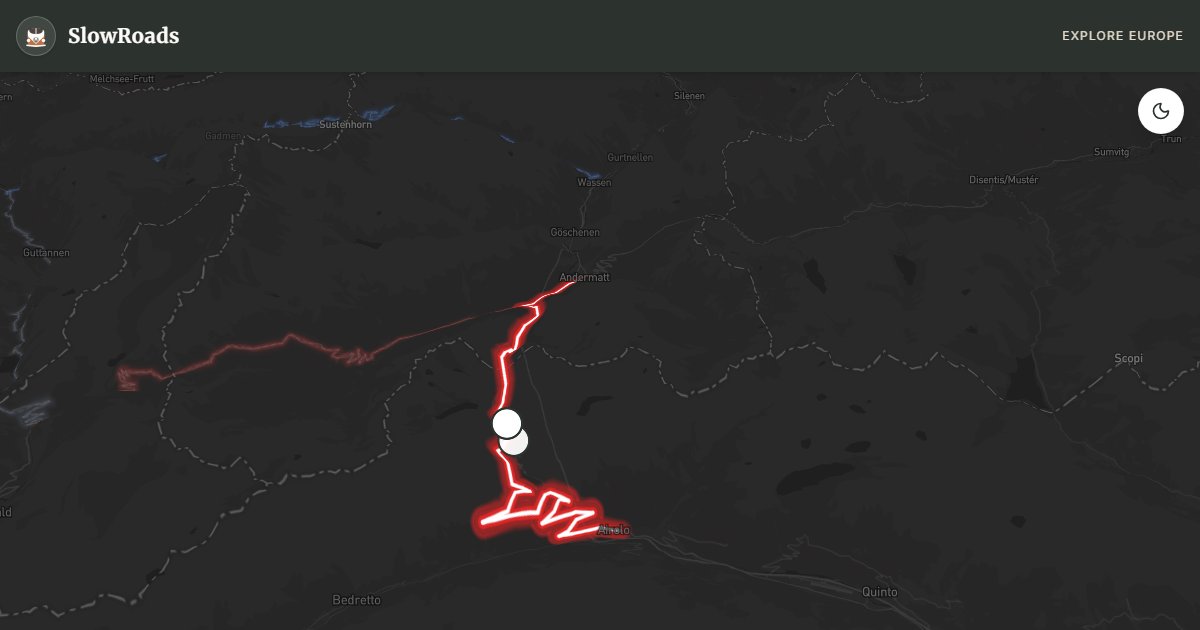
Historic Gotthard crossing on the old Tremola: granite cobbles and tight hairpins — a slow, optional classic for patient drivers in older campervans. Low clearance and soft tyres suffer; take it in first gear and yield to buses. Modern tunnel/pass alternatives exist if cobbles feel too harsh for a loaded classic. No Tremola toll; Autobahn vignette only if you use motorways. Best in dry summer weather when stones are not slick. Overnight in Airolo or Andermatt campsites after the cobbles, not on the hairpins.
Detailed Route Guide
The Gotthard Pass is the most historically significant mountain crossing in the Alps — the route through which medieval merchants, pilgrims, armies, and travellers connected northern Europe with the Mediterranean world for seven centuries. Today the Gotthard Road Tunnel (opened 1980) and the older Gotthard railway tunnel (1882), plus the 2016 base tunnel, carry almost all through traffic, and the old pass road — the Via Tremola on the southern side — has been left to history and enthusiasts. The result is one of the great slow-drive experiences in Europe: a 25-kilometre route from Airolo to Andermatt that climbs to 2,106 metres on an ancient cobblestone road whose 24 serpentines are a monument to pre-modern road engineering.
The Tremola (the name means "trembling road" — a reference to the difficulty of the crossing) is the old Via Gotthard south ramp, built in its current form during the Napoleonic period (around 1820) to replace even older mule tracks. The road is paved with hand-laid granite cobblestones (Kopfsteinpflaster) that have not been renewed since the road was active — they are worn smooth by centuries of traffic, and on a wet day they can be as slippery as ice. The cobblestones give the road an extraordinary, almost archaeological quality: you are driving on the same surface that carriages, mule trains, and marching soldiers used for two hundred years. At the summit, the Hospental of San Gottardo, a small museum built around the original medieval hospice, tells the full story of the pass from the 13th century onwards.
For a classic or low-power campervan, the Tremola is a unique and memorable challenge. The cobblestones are the primary concern: on a dry day, they provide excellent grip; on a wet day, extreme caution is needed, particularly on downhill sections. The 24 hairpins are tight but not impossibly so, and a classic campervan's turning radius is generally adequate. The gradient is consistently steep — expect sustained first-gear climbing. Allow at least two hours for the crossing, as the cobblestones enforce a natural pace of 15–20 km/h and you will want to stop and appreciate the engineering at multiple points. The modern asphalt pass road (SS2) is immediately adjacent if conditions deteriorate or the cobblestones prove too challenging — it is a perfectly good alternative and allows you to drive one way on the Tremola and return on the modern road.
The Tremola is open from approximately June to October, weather permitting. In wet conditions, the cobblestones become genuinely dangerous and the route should be avoided. The summit area and the Gotthard Museum are open in summer, and the 2-kilometre section of cobblestone road immediately south of the summit is the most dramatic and most photographed. The approach from Airolo on the Italian-speaking south side of the Alps gives a completely different atmosphere from the German-speaking north — the architecture, vegetation, and light all change as you climb, and at the summit you stand at the linguistic and cultural divide of Switzerland.
Frequently Asked Questions
Points of Interest
Tremola Cobblestones
Monument
Gotthard Pass Summit
Nature
National Saint Gotthard Museum
Monument
Route Highlights
Route Information
Navigation
* Supported by HERE Technologies, headquartered in Amsterdam, Europe. Precise routing through all waypoints.
* Waze only navigates to the starting point. Use Google Maps for the full scenic route.
Offline GPS Navigation
Download the GPX route file to navigate offline using your favorite GPS device or app (Garmin, TomTom, OsmAnd, Gaia GPS).
Ask Copilot (AI Travel Guide)
Hello! I am your SlowRoads Copilot. I know the Gotthard Pass & Tremola intimately. Ask me about scenic viewpoints, local history, hidden culinary gems, or the best camper spots along the way!