About This Route
Sightseeing-built alpine pass with glacial views, high bridges, and granite tunnels — wider than many Swiss climbs, still a long pull for classic and low-power campervans. Links perfectly with Furka and Grimsel from Andermatt for the classic Three-Pass loop. No pass toll; watch coolant on the sustained grades and use engine braking on the descent. Typically open June–October; September light beats August bikes and coaches. Fuel before you leave the valleys; overnight in Andermatt or Meiringen campsites, not on the pass.
Detailed Route Guide
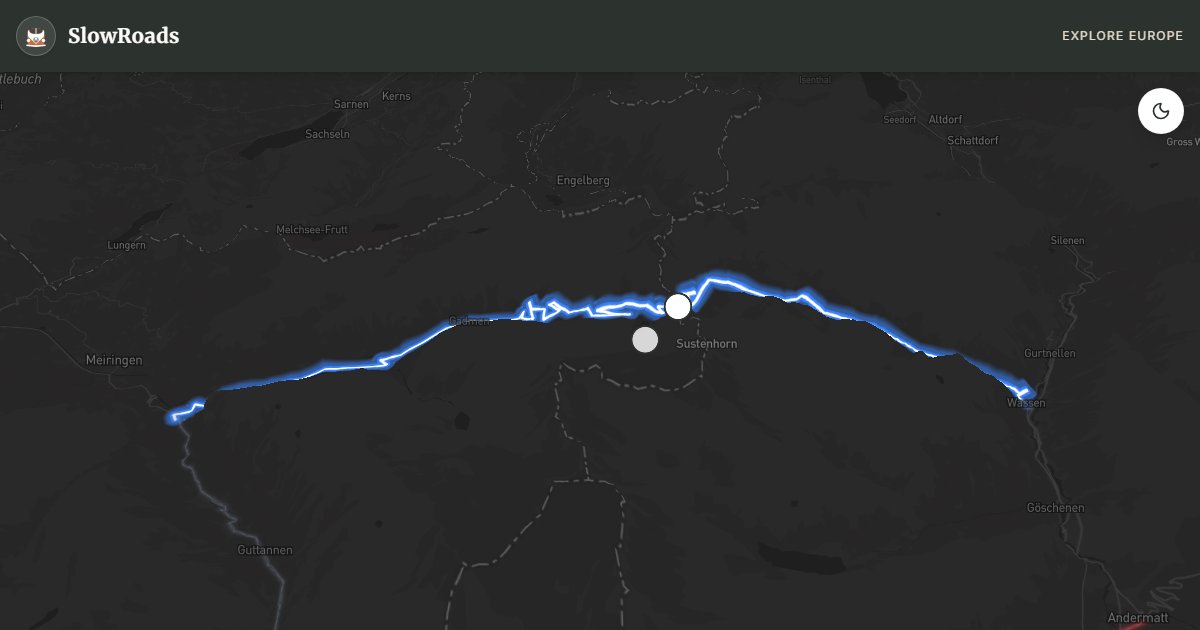
The Susten Pass is the most deliberately designed of Switzerland's great Alpine roads. Built between 1938 and 1945 specifically as a tourist drive — one of the few Swiss mountain roads conceived from the outset for scenic pleasure rather than commercial necessity — it is in many ways the most technically accomplished road in the Alps. The 43-kilometre route from Innertkirchen to Wassen crosses the Gadmen Valley, climbs through a series of tunnels and galleries carved directly into the granite massif, and reaches its summit at 2,224 metres in a landscape of raw, overwhelming grandeur.
The central attraction is the Steingletscher, a glacier that the road approaches at close quarters before the final climb to the summit tunnel. In the 1940s, when the road was built, the glacier filled the valley below the summit — today it has retreated to a remnant visible only from the higher viewpoints, and a glacial lake has formed in the void it left. The comparison between historical photographs at the viewpoints and the present reality is a sobering encounter with climate change at its most tangible. The summit itself is reached through a tunnel pierced in the rock, and the southern descent to Wassen involves the road's most spectacular section: a series of tunnels, galleries, and bridges that emerge from the cliff face with vertiginous views over the Reuss valley below.
For a classic or low-power campervan, the Susten is among the more accessible of the major Swiss passes. The road is notably wider and better engineered than many of its neighbours — it was planned from the start for tourist traffic, and the passing bays are generous and well-spaced. The gradients are significant (up to 9 percent) but not brutal, and the bends, while numerous, are less extreme than those of the Gotthard or Grimsel. Monitor your engine temperature as always on sustained Alpine climbs. The summit area has a small parking area and viewpoint that is worth a stop, and the descent to Wassen is one of the great road engineering spectacles of the Alps. Combining the Susten with Furka and Grimsel (the Three-Pass day) is the classic way to drive this pass.
The best time for the Susten Pass is June through September. July and August bring the maximum visitors and motorists. The pass typically opens in late May or early June and closes in October or November. June offers the finest snow/ice conditions at the summit — you drive through cleared roads with snowfields on both sides — while September gives golden-hour light on the granite and fewer queues. The villages on the northern approach (Gadmen, Innertkirchen) have simple mountain guesthouses and the Handeck waterfall — where the Aare River drops over a series of granite steps — is one of the finest natural spectacles in the Swiss Alps and easily accessible from the road.
Frequently Asked Questions
Points of Interest
Steingletscher
Nature
Susten Summit View
Nature
Route Highlights
Route Information
Navigation
* Supported by HERE Technologies, headquartered in Amsterdam, Europe. Precise routing through all waypoints.
* Waze only navigates to the starting point. Use Google Maps for the full scenic route.
Offline GPS Navigation
Download the GPX route file to navigate offline using your favorite GPS device or app (Garmin, TomTom, OsmAnd, Gaia GPS).
Ask Copilot (AI Travel Guide)
Hello! I am your SlowRoads Copilot. I know the Susten Pass intimately. Ask me about scenic viewpoints, local history, hidden culinary gems, or the best camper spots along the way!