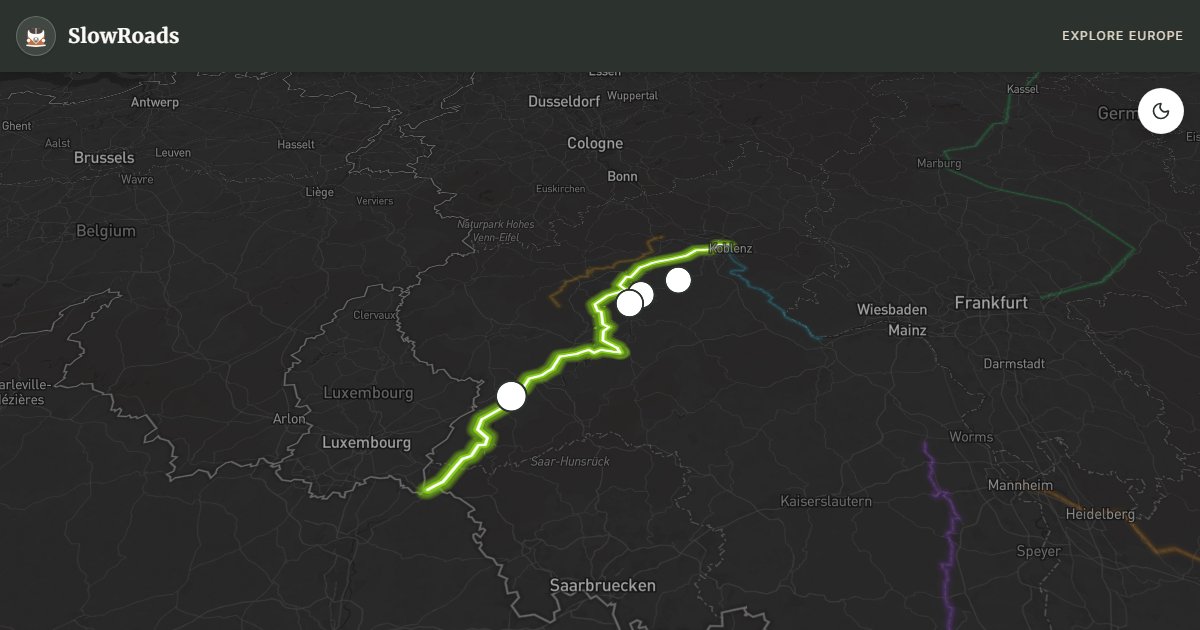
About This Route
Follow the Mosel Wine Road from Perl to Koblenz along about 175 km of riverside B-roads: slate Riesling slopes rise above a flat drive past Trier’s Porta Nigra, Bernkastel-Kues, Cochem’s Reichsburg, and a detour to Burg Eltz. Classic and low-power campervans cruise with the barges — gradients stay on the vineyards, not the road. Stellplätze and river campgrounds are frequent; village centres fill on summer weekends, so midweek harvest stops in September work best. Watch height under timber overhangs, carry coins for parking meters, and keep to the B53/B49 for stress-free flat driving.
Detailed Route Guide
The Mosel Wine Road ranks among Europe's most dramatically beautiful river drives. Over 175 kilometres from the Luxembourg border at Perl to the mighty Rhine at Koblenz, the route follows the Mosel River through a landscape of impossible geometry: vineyards clinging to near-vertical slate slopes, half-timbered villages tucked into river bends, and ancient castles perched on every strategic crag. The Mosel's meanders are so extreme that the river covers four times the straight-line distance between its mouth and the German border — which means you are never driving in a straight line and never bored.
The story of the Mosel begins in antiquity. The Romans conquered this valley in 58 BC and immediately recognised the potential of its south-facing slate slopes for viticulture. They planted vines on the slate slopes and built Trier — Augusta Treverorum — into one of the most important cities in the Western Roman Empire. The Porta Nigra, a massive Roman gate standing 2,000 years later in the city centre, is the best-preserved Roman city gate north of the Alps. The Roman Baths and the Amphitheatre complete a UNESCO World Heritage package that alone justifies a detour to Trier at the route's southern end.
From Trier, the road hugs the river north through an endless succession of wine villages. Bernkastel-Kues is perhaps the most picturesque: a market square of half-timbered burgher houses facing the vine-draped ruins of Landshut Castle above. The twin towns (separated by the river) produce some of the finest Mosel Rieslings, and dozens of family wineries welcome visitors for tastings. At Bremm, the route passes the Calmont: widely cited as Europe's steepest vineyard, with slopes of up to about 65 degrees, where harvesters use ropes and monorails to navigate the precipitous slate terraces. The contrast with the flat, winding river road below is almost comical.
Cochem's imperial castle (Reichsburg) dominates a river bend with the photogenic authority of a movie set — it was extensively rebuilt in the 19th century but no less impressive for it. From Cochem, the route winds northeast through the Terrassenmosel, where the valley briefly widens before the final bends toward Koblenz. Just before Koblenz, a short detour up the Mosel's tributary leads to Burg Eltz: a castle that has never been destroyed, captured, or sold, belonging to the same family since the 12th century. Three branches of the Eltz clan still live there. It is perhaps the most photogenic medieval castle in Germany.
For classic and low-power campervans, the Mosel is a gift. The river road (the B53/B49) is almost entirely flat, following the river bank with barely a rise. The dramatic gradients visible above — the 60-degree vineyard slopes — are for the winemakers, not you. Engine temperatures stay cool, fuel consumption is minimal, and the pace naturally slows to match the barges gliding past. The main challenge is parking in the narrow village centres during summer weekends, when German day-trippers arrive en masse for wine festivals. Arriving on a Tuesday or Wednesday in September during harvest season gives you vineyards in action and wine straight from the press.
Frequently Asked Questions
Points of Interest
Porta Nigra (Trier)
Monument
Burg Eltz
Castle
Reichsburg Cochem
Castle
Calmont (Steep Vineyard)
Nature
Route Highlights
Route Information
Navigation
* Supported by HERE Technologies, headquartered in Amsterdam, Europe. Precise routing through all waypoints.
* Waze only navigates to the starting point. Use Google Maps for the full scenic route.
Offline GPS Navigation
Download the GPX route file to navigate offline using your favorite GPS device or app (Garmin, TomTom, OsmAnd, Gaia GPS).
Ask Copilot (AI Travel Guide)
Hello! I am your SlowRoads Copilot. I know the Mosel Wine Road intimately. Ask me about scenic viewpoints, local history, hidden culinary gems, or the best camper spots along the way!