About This Route
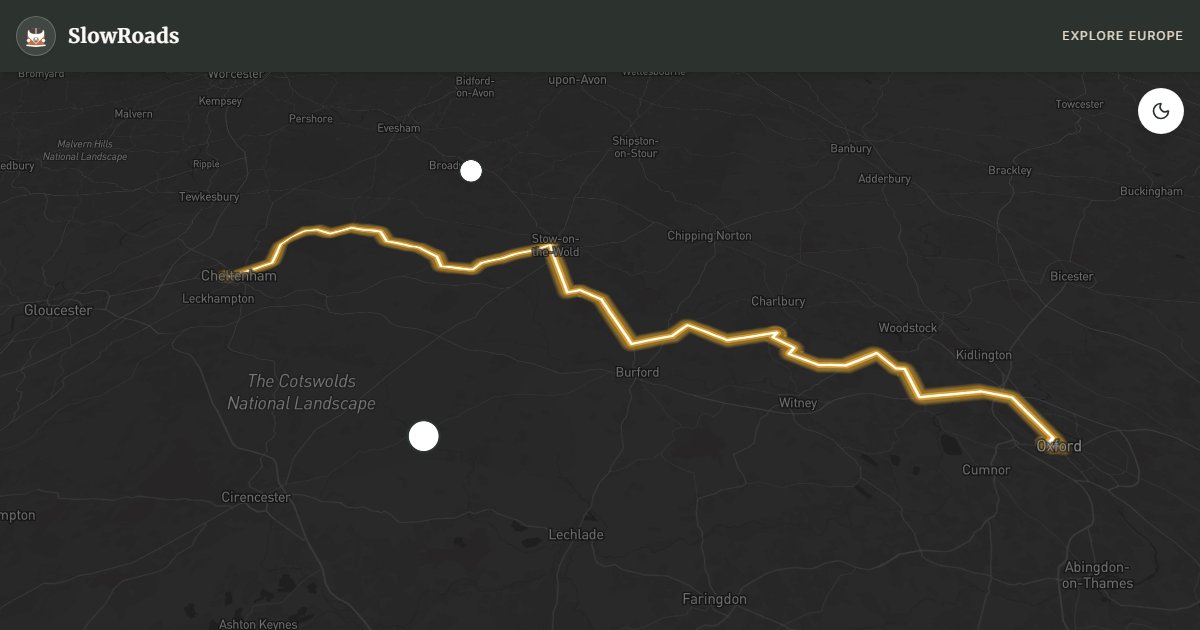
Honey-stone Cotswold villages from Cheltenham to Oxford suit classic campervans on narrow B-roads. This roughly 82 km drive links Broadway, Chipping Campden, Bourton-on-the-Water, and Bibury's Arlington Row through wool-town High Streets and hedgerow lanes. Gradients stay gentle; the challenge is parking and single-track village streets rather than climbs. Arrive early in summer, use marked passing places, and expect height barriers at some town car parks. Wild camping without landowner permission is generally illegal in England — book campsites or farm pitches near Stow-on-the-Wold or Moreton-in-Marsh. Two unhurried days beat a rushed one-day dash between tea rooms and coach parties.
Detailed Route Guide
The Cotswolds route between Cheltenham and Oxford is one of England's most celebrated short drives — 82 kilometres through a landscape that has barely changed in appearance since the wool merchants of the 15th and 16th centuries built their manor houses and churches from the local oolitic limestone. That stone, which ranges in colour from pale cream to deep amber depending on the weather and the light, gives the Cotswolds its defining visual character: a continuity of warm, honey-coloured buildings that makes every village feel like a set piece from a Jane Austen novel. For travellers in older, low-power campervans practising slow travel, this is ideal territory — the roads are narrow, unhurried, and lined with hedgerows, and the pace of life in the villages positively invites lingering.
The route begins in Cheltenham, a Regency spa town of wide promenaded streets and elegant cream-painted facades — quite different in character from the Cotswolds villages it borders but worth a morning's exploration before setting out. The B4632 north-east leads quickly into the hills, passing through Winchcombe (with its beautiful parish church; Chedworth Roman Villa lies farther south near Cirencester as a separate detour) before climbing to Broadway. Broadway is often cited as the most perfect of Cotswolds villages — its wide High Street is flanked by chestnut trees and centuries-old stone cottages — and Broadway Tower, a folly perched on a 312-metre hill above the village, offers one of the finest views in the Midlands, taking in as many as sixteen counties on a clear day. The tower was built in 1798 for the Countess of Coventry and is now open to visitors.
From Broadway, the route winds south-east through Chipping Campden — perhaps the best-preserved wool town in England, with its magnificent Perpendicular Gothic church and arched Market Hall — and on to Moreton-in-Marsh, a bustling market town astride the Roman Fosse Way. Continuing south through Stow-on-the-Wold, Bourton-on-the-Water (known as the "Venice of the Cotswolds" for its low stone bridges over the Windrush River), and the Arlington Row at Bibury — a row of 17th-century weavers' cottages beside a mill stream that William Morris called "the most beautiful village in England" — the route descends gradually towards Oxford. Bibury's Arlington Row is so photogenic that it has appeared on the UK Visitors' Passport as an image representing England abroad.
Oxford itself, a city of dreaming spires and ancient university colleges, makes a natural end point. A classic campervan parked near Jericho or along the canal towpath gives access to the city centre on foot without the stress of driving through medieval streets. The Cotswolds route is equally rewarding in any season: spring brings wildflower verges and bluebell woods, summer the full green of the hills, autumn the low golden light that turns the stone villages almost orange, and winter — when frost lies on the fields and wood smoke drifts from cottage chimneys — is arguably the most atmospheric of all.
Fuel and supplies are easy along this corridor — Cheltenham, Moreton-in-Marsh, and Oxford all have petrol stations and supermarkets — so there is no need to carry excessive weight that would slow an older engine on the few short climbs. Cash or card both work at most National Trust and village car parks, though a few rural honesty boxes still prefer coins. If you are combining this drive with the Peak District or Lake District later in a UK tour, treat the Cotswolds as a recovery leg: short distances, soft gradients, and plenty of reasons to stop walking rather than driving. That rhythm — park once, explore on foot, move on in the afternoon — is exactly how classic campervan travel thrives on English B-roads.
Frequently Asked Questions
Points of Interest
Broadway Tower
Monument
Georgian folly with Midlands panorama
Bibury
Town
Arlington Row weavers' cottages — arrive early
Chipping Campden
Town
Preserved wool town with Market Hall
Route Highlights
Route Information
Navigation
* Supported by HERE Technologies, headquartered in Amsterdam, Europe. Precise routing through all waypoints.
* Waze only navigates to the starting point. Use Google Maps for the full scenic route.
Offline GPS Navigation
Download the GPX route file to navigate offline using your favorite GPS device or app (Garmin, TomTom, OsmAnd, Gaia GPS).
Ask Copilot (AI Travel Guide)
Hello! I am your SlowRoads Copilot. I know the Cotswolds Villages (Cheltenham–Oxford) intimately. Ask me about scenic viewpoints, local history, hidden culinary gems, or the best camper spots along the way!